bpd-disaster:

rokirovka:

you know how in english, people sometimes say “pardon my french” when they swear? in russian, people say “to put it in the russian way…”

you just gotta own it, y’know

the best part of the phrase “pardon my french” is its origin

the reason ppl started saying it was rich people in the 19th (i think?) century would often travel to france and would spend the time, naturally, speaking french, then when they’d come back home they’d accidentally on purpose sprinkle a little french into conversation, hence the phrase, “Pardon my french”

eventually poorer people got sick of those rich snobs bragging about shit like that so they’d start saying “pardon my french” whenever they swore and honestly? mood

fun fact upper class snobbery is also the reason ppl look down their noses at people who say “ain’t”

dialogue-prompts:

hockeylvr42:

megan-cutler:

bead-bead:

lullabyknell:

Can I just… talk for a moment… about how much I love how, if you know them well, words don’t have synonyms?

English, for example, is a fantastic disaster. It has so many words for things that are basically the same, and I find there’s few joys in writing like finding the right word for a sentence. Hunting down that peculiar word with particular meaning that fits in seamlessly in a structure, so the story flows on by without any bumps or leaks.

Like how a shout is typically about volume, while a yell carries an angry edge and a holler carries a mocking one. A scream has shrillness, a roar has ferocity, and a screech has outrage. 

This is not to say that a yell cannot be happy or a holler cannot be complimentary, or that they cannot share these traits, but they are different words with different connotations. I love choosing the right one for a sentence, not only for its meanings but for how it sounds when read aloud. (Do I want sounds that slide together, peaceful and seamless, or something that jolts the reader with its contrast? Snap!)

I love how many words for human habitats there are. I love how cottage sounds quaint and cabin sounds rustic. I love steadiness of house, the elegance of residence, the stateliness of manor, and tired stubbornness of shack. I love how a dwelling is different to a den.

And I love how none of them can really touch the possessive warmness of all the connotations of home.

Words are great.

I did not expect to cry by the end of this, but I did.

Which proves the point, no?

“The difference between the right word and the almost right word is like the difference between a lightning bug and the lightning.” – Mark Twain (and one of my favorites, since I happen to agree with everything the OP said!)

^that is an incredible quote I’m upset I’ve never heard it before

❤️

deadcatwithaflamethrower:

leupagus:

haviary:

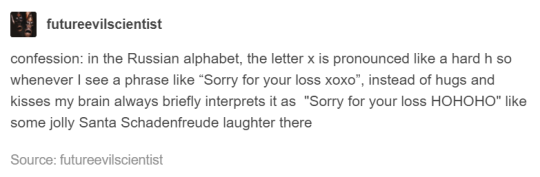
the fact that the Russian language doesn’t have articles makes me go ??????????????? because in a native English speaker’s head it sounds like a hilarious shitpost type thing

 so when you ask someone “Где водка?” it translates to “where is the vodka?”

 but in my horrible backwards english brain if I don’t see any articles I assume they aren’t there, so yelling “ГДЕ ВОДКА” translates to “WHERE VODKA” like some kind of drunken maniac who you definitely should not give vodka to

Speaking as a Russian-American who speaks the language and knows a fair share of Russian-Russians, even if Russians did have articles they would still slam open the door yelling “WHERE VODKA” at all times.

I see nothing inaccurate here.

ademska:

reliand:

sergeantjerkbarnes:

simplydalektable:

hannahrhen:

sergeantjerkbarnes:

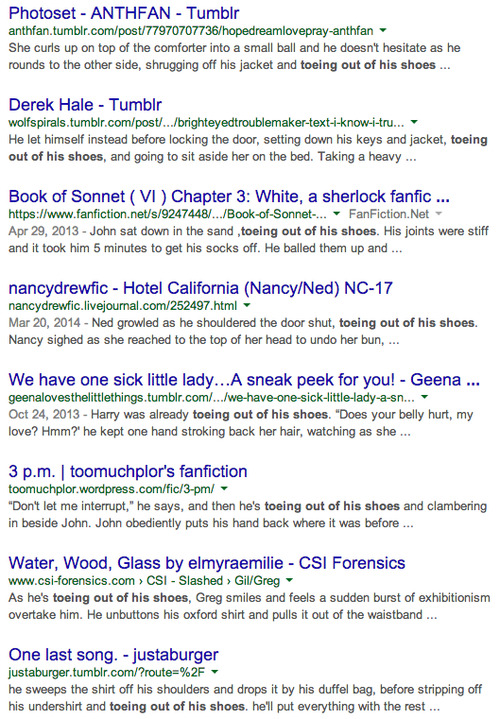
so i just googled the phrase “toeing out of his shoes” to make sure it was an actual thing

and the results were:

image

it’s all fanfiction

which reminds me that i’ve only ever seen the phrase “carding fingers through his hair” and people describing things like “he’s tall, all lean muscle and long fingers,” like that formula of “they’re ____, all ___ and ____” or whatever in fic

idk i just find it interesting that there are certain phrases that just sort of evolve in fandom and become prevalent in fic bc everyone reads each other’s works and then writes their own and certain phrases stick

i wish i knew more about linguistics so i could actually talk about it in an intelligent manner, but yeah i thought that was kinda cool

Ha! Love it!

One of my fave authors from ages ago used the phrase “a little helplessly” (like “he reached his arms out, a little helplessly”) in EVERY fic she wrote. She never pointed it out—there just came a point where I noticed it like an Easter egg. So I literally *just* wrote it into my in-progress fic this weekend as an homage only I would notice. ❤

To me it’s still the quintessential “two dudes doing each other” phrase.

I think different fic communities develop different phrases too! You can (usually) date a mid 00s lj fic (or someone who came of age in that style) by the way questions are posed and answered in the narration, e.g. “And Patrick? Is not okay with this.” and by the way sex scenes are peppered with “and, yeah.” I remember one Frerard fic that did this so much that it became grating, but overall I loved the lj style because it sounded so much like how real people talk.

Another classic phrase: wondering how far down the _ goes. I’ve seen it mostly with freckles, but also with scars, tattoos, and on one memorable occasion, body glitter at a club. Often paired with the realization during sexy times that “yeah, the __ went all they way down.” I’ve seen this SO much in fic and never anywhere else

whoa, i remember reading lj fics with all of those phrases! i also remember a similar thing in teen wolf fics in particular – they often say “and derek was covered in dirt, which. fantastic.” like using “which” as a sentence-ender or at least like sprinkling it throughout the story in ways published books just don’t.

LINGUISTICS!!!! COMMUNITIES CREATING PHRASES AND SLANG AND SHAPING LANGUAGE IN NEW WAYS!!!!!!!

I love this. Though I don’t think of myself as fantastic writer, by any means, I know the way I write was shaped more by fanfiction and than actual novels. 

I think so much of it has to do with how fanfiction is written in a way that feels real. conversations carry in a way that doesn’t feel forced and is like actual interactions. Thoughts stop in the middle of sentences.

The coherency isn’t lost, it just marries itself to the reader in a different way. A way that shapes that reader/writer and I find that so beautiful. 

FASCINATING

and it poses an intellectual question of whether the value we assign to fanfic conversational prose would translate at all to someone who reads predominantly contemporary literature. as writers who grew up on the internet find their way into publishing houses, what does this mean for the future of contemporary literature? how much bleed over will there be?

we’ve already seen this phenomenon begin with hot garbage like 50 shades, and the mainstream public took to its shitty overuse of conversational prose like it was a refreshing drink of water. what will this mean for more wide-reaching fiction?

QUESTIONS!

Blind people gesture (and why that’s kind of a big deal)

superlinguo:

People who are blind from birth will gesture when they speak. I always like pointing out this fact when I teach classes on gesture, because it gives us an an interesting perspective on how we learn and use gestures. Until now I’ve mostly cited a 1998 paper from Jana Iverson and Susan Goldin-Meadow that analysed the gestures and speech of young blind people. Not only do blind people gesture, but the frequency and types of gestures they use does not appear to differ greatly from how sighted people gesture. If people learn gesture without ever seeing a gesture (and, most likely, never being shown), then there must be something about learning a language that means you get gestures as a bonus.

Blind people will even gesture when talking to other blind people, and sighted people will gesture when speaking on the phone – so we know that people don’t only gesture when they speak to someone who can see their gestures.

Earlier this year a new paper came out that adds to this story. Şeyda Özçalışkan, Ché Lucero and Susan Goldin-Meadow looked at the gestures of blind speakers of Turkish and English, to see if the *way* they gestured was different to sighted speakers of those languages. Some of the sighted speakers were blindfolded and others left able to see their conversation partner.

Turkish and English were chosen, because it has already been established that speakers of those languages consistently gesture differently when talking about videos of items moving. English speakers will be more likely to show the manner (e.g. ‘rolling’ or bouncing’) and trajectory (e.g. ‘left to right’, ‘downwards’) together in one gesture, and Turkish speakers will show these features as two separate gestures. This reflects the fact that English ‘roll down’ is one verbal clause, while in Turkish the equivalent would be yuvarlanarak iniyor, which translates as two verbs ‘rolling descending’.

Since we know that blind people do gesture, Özçalışkan’s team wanted to figure out if they gestured like other speakers of their language. Did the blind Turkish speakers separate the manner and trajectory of their gestures like their verbs? Did English speakers combine them? Of course, the standard methodology of showing videos wouldn’t work with blind participants, so the researchers built three dimensional models of events for people to feel before they discussed them.

The results showed that blind Turkish speakers gesture like their sighted counterparts, and the same for English speakers. All Turkish speakers gestured significantly differently from all English speakers, regardless of sightedness. This means that these particular gestural patterns are something that’s deeply linked to the grammatical properties of a language, and not something that we learn from looking at other speakers.

References

Jana M. Iverson & Susan Goldin-Meadow. 1998. Why people gesture when they speak. Nature, 396(6708), 228-228.

Şeyda Özçalışkan, Ché Lucero and Susan Goldin-Meadow. 2016. Is Seeing Gesture Necessary to Gesture
Like a Native Speaker?
Psychological Science

27(5) 737–747.

Asli Ozyurek & Sotaro Kita. 1999. Expressing manner and path in English and Turkish:
Differences in speech, gesture, and conceptualization. In Twenty-first Annual Conference of the Cognitive Science Society (pp. 507-512). Erlbaum.