Thinking about how Tobirama went into such detail about the “Uchiha Curse”, I had a thought: what if he intended the Uchiha to be the last line of defense for the village?
That seems like an obvious statement – he had assigned them as the police inside Konoha, of course they would defend the village if anyone got that far. But I think the thought behind it was more complicated than that. Tobirama basically said he’d given them a job they were suited to when pressed about it. The Uchiha can copy any jutsu, have massive chakra and can predict an enemies movements. This makes them excellent shinobi all-around, but does indeed make them specially suited to policing and apprehending unruly ninja. But Tobirama didn’t mention this anywhere in his explanation – he kept bringing up the Curse.
The Curse of Hatred: Uchiha suppressing intense emotions to the point that when they are released (usually in times of great turmoil) they develop the sharingan (if they don’t have it, they get it, if they have it it evolves) and their power increases exponentially, short and long-term. With the unfortunate side effect of often making them tend to lean toward rabidly insane. See: Madara, Obito, Sasuke.
Tobirama has studied this over his entire life. Seen first-hand as the sharingan has evolved on the battlefield in enemies he’s fought, or watched it bloom in the eyes of the survivors as they glare and retreat. He watched Madara’s steady decent into a madman that abandoned his village as his eyes grew more and more powerful – reduced from the kind, family oriented man Hashirama first met to a deluded lunatic who would attack and torture members of his own clan in his unquenchable hate. All because his beloved brother Izuna was killed. In this light, every single Uchiha is a ticking time-bomb.
Keeping them in the village put them in an environment where they
weren’t being stressed out so much and alleviated this danger. Canon (or at least word-of-god)
says there weren’t a lot of Uchiha with the sharingan at the time of the
massacre, which supports this. Certainly Tobirama would have seen the Uchiha safe inside Konoha, using their strengths to maintain order better than anyone else, and noted the uptick in them keeping their sanity intact. Making their in-village position official was logical. The Uchiha themselves were safer and happier overall, and everyone was safer from them.
But that Curse would have also been a tempting contingency.
Any enemy of the village who made it to the village would be confronted by an entire clan of fire-breathing berserkers where they expected competent, but pampered policemen.
By Tobirama’s reign alone, it would have been an entire generation since the Uchiha were on the battlefield properly. Sure, there would be one or two out on teams, but not as a large group. Not as brothers and fathers, and sisters and mothers, and cousins and uncles side by side as an army, red eyes ever-watching, ever evolving as their kin died beside them. Probably no one had killed an Uchiha loved one and lived to tell about the resulting carnage in decades. No one would have been wary of the instant backlash anymore. See: Obito. The shinobi that cut Kakashi’s eye was entirely unwary of Obito and died quickly for it. Tobirama could even have used the newly formed Anbu to wipe out information about the Uchiha outside the village specifically to cause enemies to be unwary when killing an Uchiha’s loved one. There probably aren’t any surviving records in enemy hands about nearby Uchiha suddenly turning savage and twice as strong if you killed one of them, or how sometimes one would start screaming as the body fell and take a suicide run into the nearest group of enemies and decimate dozens before they were brought down.
I think the Uchiha Curse of Hatred wasn’t something Tobirama could get rid of and knew it, but it was something he could direct and use. And did.
If anyone got past the vanguard and defenses comprised of the Senju and other assorted clans of Konoha, they would be expecting weaker shinobi, or, at-best, think they understood how the sharingan worked (copies jutsu and tracks movement – lol, easy) and rush in half-cocked. And start killing people. And the Uchiha would inevitably rise like the many heads of the Hydra – cut one down and another twice as strong and three times as vicious is coming at you from the left.
I think Tobirama intended the Uchiha to be an integrated part of the village. They supposed to love it and the people in it deeply.
Recall: Tobirama expressed surprise and said he couldn’t believe the clan was on the brink of extinction when he was told Sasuke was the last. He does mention concern about Madara’s adherents within the clan, but clearly the clan as a whole was meant to be safe and stable in the village.
His failure was in thinking too much about the system he was developing and not enough about the people. How people resenting the police and how the logic of putting the clan in charge of the prison, beside the prison would isolate them socially and physically, and (most importantly), how his successors would interpret his warnings and intentions. Danzo (and Hiruzen) seem to have listened too closely to Tobiramas words about the strength and danger of the Uchiha and not enough on their suitability as protectors. Penning them into an even more remote district post-Kyuubi and cutting them off from everyone else would have messed that plan for the Curse up; effectively reversing the founding of the village for the Uchiha.
At their end, the Uchiha’s love was turned inward to themselves; exactly as it had been before.
Y’all asked for it so y’all gonna get it! I’mma start off with the barebones essentials and work my way to basic definitions. Sit down on something comfy and get yourself your warm beverage of choice and maybe grab a notebook because here goes.
What are runes?
Runic alphabets have been around since about 150 AD and used as a writing system by a lot of Germanic languages. These systems were eventually phased out, slowly but surely, with the progressive Christianisation that started around 700-1100 AD. The three most commonly known (and used?) Are the Elder Futhark, the Younger Futhark and Futhorc.
Runes aren’t, themselves, broadly meant for divination, thought there are a few passages in the Eddas that mention Odin “finding” and using them.
Alright, so which alphabet should I use?
Whichever one you want! I prefer using the Elder Futhark, because it’s the first alphabet I learned and got familiar with, but that doesn’t at all stop you from using the Younger Futhark or Futhorc. I’d heavily suggest making sure you read up on the differences in each alphabet though; Ansuz, for example, won’t look the same, mean the same or even be called the same from one alphabet to another.
Familiarize yourself with each of them if you want/can, and choose based on your own preferences and criteria. Always work with what feels best for you!
But I’m not really familiar with Germanic traditions / I’m a baby witch, should or can I use runes for divination?
This is the concept that got my goat real good the first time. You do not, in any way, shape or form, need to be experienced to cast runes. This is a notion that is outdated and perpetuated by gatekeepers and exclusionists. No one gives a flying flip how long you’ve been practicing witchcraft, or if you even practice at all!
Divination should be seen as a tool to further yourself and/or your craft. It can be used by itself or in conjunction with other activities, practices or beliefs. I was 15 when I started learning about runes (dear god that was literally over ten years ago) and I had no idea what I was doing back then. I read up as much as I could about the system I was wanting to use and, once I was comfortable with it, I started doing small readings.
It shouldn’t matter how new or familiar you are to divination, rune casting or Germanic traditions. If rune casting feels right to you, you are more than free to use whatever divination method feels right to you.
What should I do before I start a reading?
As a Norse Pagan, I usually invoke my patron deities (Baldr and Loki, in this case), as well as Odin and Freyja, sometimes Gullveig/Heiðr because reasons. I have no idea whether or not this has any actual bearing on the reading itself, as mine were as accurate before I converted as they are now.
Making sure you’re in a quiet and/or comfortable space is also a good idea, even if that just means popping in some earphones and listening to something that makes you focus and feel calm.
This is also a good time to mention that cleansing your runes (stone, bone, wood or otherwise) is a very good idea. I typically do this with candles, incense, a bowl of water and a point of quartz for each element. I don’t do this nearly as often as I probably should, since most people suggest cleansing them after each reading… but, whatever, being lax with that hasn’t bitten me in the ass so far. So if you’re a spoonie, don’t worry: cleanse your runes when you feel they need to be cleansed, and that’s it.
Alright, I think I’m ready; how do I start reading?
Let me start by saying that the bullshit about never reading yourself? It’s just that. Bullshit. Do readings on yourself if you want to. Who the hell is going to stop you. Do whatever you want.
On that note, there are a few ways to cast runes, though these probably aren’t close to being the only ones:
Intuitively choosing the stones Lay the runes down on a flat surface and let your hand hover over them and pick out the ones that feel right. You can either pick them in order of the spread you’re using, or place the runes where you feel they belong on the spread.
Throwing the stones Make sure you have a large flat surface to work with (preferably the floor honestly) where you won’t drop, scatter or lose a rune. You can use a mat underneath, and read the stones that fall on the corresponding positions in the spread or circle. (You can find many of these with a quick google search, or make your own mat!) Otherwise, you can take the first stones you see facing up and lay those out according to your spread.
Picking them blindly Either you or the person you’re reading pull stones blinding out of a pouch, bag or other container, and lay them out according to the spread you’re using. Pretty straightforward.
If you can think of another method, literally nothing is stopping you from using that instead. The runes are acting as a universal translator for whatever it is you’re tapping into. They’re just a tool to receive a message. How you choose to receive that message is completely up to you!
So I’ve got my runes laid out, now what?
Now comes the fun part. I can only really give you a good run-down of the Elder Futhark, and though it’s a good starting point, I would highly advise you do your own research on whatever alphabet you want to use. Wikipedia is a great place to start, but don’t stop there: look at several different websites and lists and compare. Combine and condense the information for yourself, and get to learn the definitions and meanings for yourself!
ᚠ Fehu • catle wealth, money, hard work paying off, can represent spiritual wealth reversed: effort gone to waste, natural and/or financial loss, greed
ᚢ Uruz • ox physical strength and speed, great energy, courage, masculine reversed:physical weakness, illness, violence, misdirected aggression
ᚦ Thurisaz • thor reactive, destructive and/or defensive force, tendency towards change reversed: dangerous compulsions, betrayal and malice, lies, spite
ᚨ Ansuz • of the Æsir revelations, intuition, signs and signals, wisdom, power of words/names reversed: misunderstandings, delusions and vanity
ᚱ Raido
• chariot physical/spiritual journeys, transition, seeing the bigger picture reversed: crisis, maybe due to stagnation, unwanted disruption
ᚲ Kaunan
• torch creativity and inspiration, power of transformation, power of life reversed: instability, lack of creativity, false hope revealed, disillusionment
ᚷ Gebo
• gift gifts in the form of sacrifice or generosity, contracts, partnerships reversed/opposed: greed, isolation and dependence, over-sacrifice
ᚹ Wunjo
• joy comfort, pleasure, companionship, possibility of going over the top reversed: sorrow and alienation, growing distance, raging frenzy
ᚺ Hagalaz
• hail wrath of nature, destruction for the sake of creation, natural order reversed: natural disasters, powerlessness, suffering
ᚾ Naudiz
• need strength/growth from hardships, survival, determination reversed: deprivation and emotional starvation, constraints/restraints
ᛁ Isaz
• ice challenges and frustration, psychological block, anticipation reversed/opposed: can oppose other runes with malice and treachery
ᛃ Jera
• good year hard work is fruitful, peace, happiness and relief, breaking the cycle reversed: sudden setbacks and bad timing
ᛈ Pertho
• vagina secrets, mysteries, undiscovered abilities, choosing your own path reversed: stagnation, isolation and loneliness
ᛇ E/ihwaz
• yew tree strength, stability, endurance, trustworthiness, your goal is realistic reversed: confusion, dissatisfaction and weakness of the mind
ᛉ Algiz
• elk shield, the instinct to protect yourself/others, connection to the gods reversed: hidden dangers, loss of link to the divine, turning away
ᛊ Suwilo
• the sun success and goals achieved, you have the power you need to succeed reversed/opposed: deception, false goals, gullibility, divine wrath
ᛏ Tiwaz
• tyr honour and leadership, authority, success in competitions reversed: artistic block, over-analysis and sacrifice, imbalance/conflict
ᛒ Berkana
• birch tree fertility in a broad sense, personal/physical growth, new beginnings reversed: family/relationship issues, anxiety over loved ones, abandon
ᛖ Ehwaz
• horse steady and gradual progress, teamwork/loyalty, relationships reversed: reckless haste and its consequences, restlessness
ᛗ Mannaz
• mankind the self, the human race, your attitude toward others and vice-versa, social awareness, altruism reversed: mortality, self-deception, cunning and manipulation
ᛚ Laguz
• water literal/metaphorical flow, imagination, the unknown, chance of loss reversed: confusion/uncertainty, may be making the wrong choice
ᛝ Ingwaz
• probably freyr warmth and love in general, tying loose ends, relief, freedom to move reversed: moving without change, fruitless effort, helpelessness
ᛞ Dagaz
• dawn breakthroughs and clarity, security, power to change and grow, the ideal reversed/opposed: endings and coming round full circle
ᛟ Othila
• inheritance ancestral property, what is most important, spiritual heritage and safety reversed: slavery, homelessness, bad karma, what one is unwillingly bound to
Phew! What a list. These are just brief descriptions and meanings that I’ve been able to compile and condense over the years.
But, what does “opposed” mean?
I see where you’re coming from. As a baby diviner, I, also, was confused by this. But let me explain how I’ve come to understand it!
Sometimes, if you’re doing a set spread, you’ll have a spot for things like, “what will oppose you”, or “what you need to avoid”. Things like that. If, say, a rune like Suwilo was found in something like that, you’d want to try and keep a sharp mind to avoid deceptions or letting yourself be too gullible.
When runes don’t have a reversed form, their position in your spread will usually determine what they mean. (Though really this is true for literally any rune.)
Anything else I should know?
The best advice I can ever give anyone is to always do what you feel is right. If you find yourself wondering, “Should I do this? Is this right?” If you question yourself at all, you should probably not to the thing and go with something else.
It’s also important to mention that the names I have for the runes may not be the ones that you’ve learned to know them by; a lot of runes can go by different names depending on who you ask and where you look. Do your research, and know the runes by the names you feel are best! (And preferably historically accurate.)
As always, if you have any questions regarding runes and how to read them, please ask me! My ask box is literally always open and almost always empty.
Today we announced some big updates to our Community Guidelines and what kind of content is permitted on Tumblr. Adult content will no longer be allowed here. While we do not judge anyone for their desire to post, engage with, or view this stuff, it is time for us to change our relationship with it.
We expect you may have some questions on how this will affect you, and we’re here to make sure those questions get answered.
When does the new policy take effect?
Our new Community Guidelines will go into effect on December 17, 2018.
Newly uploaded content flagged as adult will no longer be allowed on Tumblr. We’ll also begin flagging and removing existing adult content with the ultimate goal of removing as much of it as we can.
What is considered adult content?
Adult content primarily includes photos, videos, or GIFs that show real-life human genitals or female-presenting nipples, and any content—including photos, videos, GIFs and illustrations—that depicts sex acts.
What is still permitted?
Examples of exceptions that are still permitted are exposed female-presenting nipples in connection with breastfeeding, birth or after-birth moments, and health-related situations, such as post-mastectomy or gender confirmation surgery. Written content such as erotica, nudity related to political or newsworthy speech, and nudity found in art, such as sculptures and illustrations, are also stuff that can be freely posted on Tumblr.
What about Safe Mode?
Our new policy negates the need for Safe Mode so this feature will no longer exist. These new policies are the same regardless of your age. Read more here.
My content was flagged, but I don’t think it should be. What should I do?
If you feel that we have categorized your post incorrectly, you can appeal this decision with the form that was sent to you via email or use the button on the post in question. Please note that this process is only possible to complete on the web or with Tumblr app version 12.2 or higher.
Read more about how to review your content and appeal here.
What goes into classifying content as adult?
This work requires a mix of machine-learning classification and human moderation by our Trust & Safety team—the group of individuals who help moderate Tumblr. We’ve been expanding the team to handle the increased workload, and we will continue to expand as needed.
Computers are better than humans at scaling process—and we need them for that—but they’re not as good at making nuanced, contextual decisions. This is an evolving process for all of us, and we’re committed to getting this right. That’s why when you appeal a post we’ve marked as adult, it gets sent to a real, live human who will look it over with their real, live human eye(s).
Will I see any adult content on Tumblr after December 17, 2018?
Due to the technical challenges that come with moderation at scale you may continue to see some adult content. This is true for all types of content that might be in violation of our guidelines. At any given moment, millions of people are posting to Tumblr. To review everything and to get it right is complex, but we’re committed to continuously improving.
As always, if you see a post with adult content that you don’t want to see, you can report it directly to our Trust & Safety team. Learn about how to report content here.
What will happen to my adult content already on Tumblr?
Starting today, we will begin sending out email notices to members of the Tumblr community whose content has been flagged as adult. This email will provide a link to the post(s) in question and a form to appeal our decision if you think we have made a mistake. Starting on December 17, 2018, any post(s) that have been flagged will be reverted to a private setting viewable only by you. If you want to learn more about how to see those posts, please visit our Help Center.
You can also download the contents of your blog(s) before these policy changes take effect. Find out how here.
What if my blog (not to be confused with posts) was marked as “explicit” before December 17, 2018?
Blogs that have been either self-flagged or flagged by us as “explicit” per our old policy and before December 17, 2018 will still be overlaid with a content filter when viewing these blogs directly. While some of the content on these blogs may now be in violation of our policies and will be actioned accordingly, the blog owners may choose to post content that is within our policies in the future, so we’d like to provide that option. Users under 18 will still not be allowed to click through to see the content of these blogs. The avatars and headers for these blogs will also be reverted to the default settings.
You can check and see if your blog is marked as explicit per our old policy in your visibility settings. If you think your blog has been erroneously marked as explicit, please send an appeal here.
Will I get kicked off of Tumblr if I’ve uploaded adult content in the past?
We’re removing content, not people. However, those who repeatedly and deliberately post new content that violates our updated guidelines may have their account deactivated per our Terms of Service. If you feel you’ve been incorrectly suspended, you can appeal here.
What if I reblogged adult content?
The original poster of the content will be notified of its removal, and it will no longer be on your blog.
What if I have more “What if” questions?
We got you. You can review our updated Community Guidelines right over here. If you still haven’t found an answer to your question, you can ask our support team.
❤ Tumblr
Written content such as erotica, nudity related to political or newsworthy speech, and nudity found in art, such as sculptures and illustrations, are also stuff that can be freely posted on Tumblr.
Typically a dumb person, used as a insult like “idiot”
Oh ok so what’s an evangelist
People who think that is a “church”
Isn’t that a football stadium?
No that’s Joel Osteen’s “church”
…I don’t buy it. Not a single icon or stained glass window in the place.
If you hate the designs of protestant mega churches, you’re REALLY gonna hate their idea of communion
….okay so I can resign myself to the stadium church. It’s not my god to start with so whatever.
But I can HEAR MY GRANDFATHER BEING UPSET IN HIS AFTERLIFE ABOUT THAT COMMUNION.
What the fuck is with the American syncretic folk Xtianity. What is wrong with these people.
*scrubs face* This is the tail end of a process that started in the late 80s/early 90s.
First, there was the dismantling of any reliable information on what defined a cult. You can thank Scientology for that part; they bought up or sued into nonexistence support networks designed to tell people when they were getting involved with a cult and not a legitimate expression of religious faith. I think I’d stopped seeing reliable sources on the ‘net by about 1995 or so. Those support networks had existed since…the fifties or sixties, I think, because one of the side effects of all those free love hippie communes and what not was that every charsimatic psychopath out there had a fair chance at acquiring a following too.
So that was the first step. The second was slower. Because the psychopaths who’d worked out that religion is a great way to gain followers, gain funds, and get away with just about anything – first witness, Scientology, second witness, televangelists.
The second step was entrepreneurial psychopaths finding (largely rural) churches and slowly taking them over, making them “nondenomenational” or “assemblies of god”. (If you think I’m whaling on AoG here, go look them up – they are basically a franchise operation where individual ministers can do more or less what they like with minimal oversight.) This is important. Denominations have structures. They have rules. Individual ministers/preachers/etc can be held to account by people higher up the ladder. If there is no oversight, there is no responsibility.
There are also no taxes. Religious institution, remember? This is why this kind of operation looks so tantalizing to a particular type of psychopath. All the religious authority of a minister, freedom from taxes, and no one to hold you accountable but God, who never calls the cops on anybody.
These nondenominational/AoG churches have been slowly spreading/increasing across the rural US for decades. They spread because operational costs rise and traditional denominations pull out, and sometimes they spread because a charismatic psychopath in the area realizes he can totally sway the parishoners better than the local minister can, and drives that minister out. In a lot of rural areas the church is and has always been the center of community life, and not going to church (and the same church as the important people in town) can get you in trouble. So taking over the local church is taking on a lot of local authority.
This has been going on long enough now that entire generations of people have grown up with a local cult leader in charge of their area, and it is normal, and there is nothing anymore to tell them it isn’t. On the contrary, it’s now reinforced, as these are the churches that send the GOP funds and keep them in power, and the rhetoric of the local minister is now echoed on Fox News. You want to know why the red states are so red? It’s a lot to do with these churches. You want to know why “pro-life” and “anti-gay” are so much the heart of these supposedly christian churches? Because they’re cults, and one of the defining characteristics of a cult is defining the out-groups, and vilification of the out-groups. Another is absolute control over the sex lives of cult members. The pro-life movement, as many have noted, isn’t ‘pro life’ at all – it’s anti-woman. It’s about keeping women under control. That’s not an accident.
Televangelists are broader reach but not particularly different in scope. Their goal is money rather than control – con men rather than cult leaders. However, their roles are complementary enough that you wind up with a lot of the same rhetoric. This isnt’ about reaching people or helping people. This is about making money and accruing power, and stadium sized megachurches and prepackaged minicommunions are just one facet of the whole.
This doesn’t really cover the pockets of fiercely-defended cult that actually pre-existed all this, as those do operate somewhat differently, but this is still… a really, really good summation of what the fuck even happened and how we got to the modern mega-church/televangelist phenomenons in the US.
It should come as no surprise that the shift* in the Republican party towards the modern iteration of the GOP and all its awful batshittery, identifiably got started in the 80s and progressed through the 90s simmering away towards a slow boil. Eventually it got super-heated; in the late 2000s and 2010s, the pot flash-boiled over in response to being inexorably and undeniably disturbed on a number of fronts.
*Look, Goldwater-style Republicans were no saints and I’m definitely not here to paint them as folk-heroes or whatever, but there WAS an identifiable shift – one that Barry Goldwater himself identified and was genuinely concerned about its implications for functional government, which should tell you everything really. If you want to say it was a shift only in magnitude, that pre-existing ugly currents got amplified and given center stage, I don’t disagree; but, sometimes a shift in magnitude is sufficient that it constitutes a shift in kind as well. But honestly it doesn’t matter how, precisely, we characterise the shift: it still was a shift.
There’s another story that I like about a Chinese general who had to defend a city with only a handful of soldiers from a huge enemy horde that was in all likelihood going to steamroll the place flat within hours of showing up.
So when said horde did arrive, they saw the general sitting outside the city’s open gates, drinking tea. The horde sent a couple of emissaries over to see what was what, and the general greeted them cheerfully and invited them all to come and take tea with him.
The horde decided that this was a scenario that had “MASSIVE FUCKING TRAP” written all over it in beautiful calligraphy and promptly fucked off.
Whoever that general was, he was clearly the Ancient Chinese equivalent of Sam Vimes.
did he just invite us over for tea nah man i’m out
This just keeps getting better
I fucking love history.
ok but tbh that story misses a lot of the subtlety of the situation like ok
so this story is the Romance of Three Kingdoms, and essentially takes place between Zhuge Liang, resident tactician extraordinaire, and Sima Yi… OTHER resident tactician extraordinaire.
The two were both regarded as tactical geniuses and recognized the other as their rival. Zhuge Liang had a reputation for ambushing the SHIT out of his opponents and using the environment to his advantage, thus destroying large armies with a small number of men. Sima Yi (who kind of entered the picture later) was a cautious person whose speciality was unravelling his opponent’s plans before they began. So it was natural that the two would butt heads; however, since Sima Yi tended to have more men and resources, he started winning battles against the former. Which, y’know, kinda sucked.
On to the actual story: Zhuge Liang is all like “shit i gotta defend this city with like 10 men.” Literally if he fights ANY kind of battle here, he WILL lose; his only option for survival is not to fight. And that’s looking more and more impossible until he hears that his rival is leading the opposing army. And then he gets this brilliant idea. He basically opens all the gates, sends his men out in civilian clothes to sweep the streets, and sits on top of the gate drinking tea and chilling out and basically makes the whole thing out to be a trap
When Sima Yi comes he’s all like “yo come on in bro”
and Sima Yi is like “yeah he’s never been that obvious about his traps before. this is definitely a bluff” and he’s about to head in when he realizes
wait. he knows that i think he’s bluffing.
and so he gets it in his head that maybe, just MAYBE, Zhuge Liang has this cunning plan that will wipe out his army – recall that he has a pretty good handle on what his rival is capable of. And after a long period of deliberation (which is just like “he know that I know that he knows that etc.”), being the cautious man he is, SIma Yi eventually decides to turn his entire army around and leave.
Zhuge Liang later points out that the plan was based specifically on the fact that he was facing his rival; if it had been anyone else, there’s no way it would have worked. A dumber or less cautious person would have simply charged in and won without breaking a sweat.
and that’s the real genius here: it was a plan formed entirely just to deceive one man, and it worked.
Zhuge Liang is the most brilliant, sneaky-ass bastard in history. One time his side’s army was out of arrows, which pretty much meant they were screwed. So Zhuge Liang goes and does the logical thing, which is build a fuck ton of scarecrows and put them all on boats. Then he makes the men hide in the boats and sail them out on the river.
Well, that day was super foggy (which Zhuge Liang had predicted. Did I mention he was also a freakishly accurate meteorologist?). So the enemy across the river sees a fleet of boats armed to the teeth with what appears to be half an army of men. They panic! and start firing arrows like crazy.
Zhuge Liang lets this play out for a while, then he’s like, ”Ok guys that’s enough.” They calmly turn the boats around and go back to base, where they dismantle the scarecrows and pull out all the enemy’s arrows.
Zhuge Liang is legend.
I love this post. It just keeps getting better. Like seriously, I would have adored learning about this in World History.
It got better
Zhuge Liang is my fucking hero, y’all battle tacticians have nothing on him.
I’ve always loved collecting books. I’ve got enough books that my friends make jokes about using stacks of books as furniture – not true, but close enough. But there is one type of book that I’ve never been able to get my hands on: fanfiction and other independently written, underground work. Especially work with queer themes and/or erotica.
It’s frustrating that fanfiction isn’t generally publishable or sellable. It’s a shame that creators could spend months or years laboring over a phenomenal piece of work and never see a dime for it, never see it in print. So I finally hit on an idea, an attempt to thank the authors of these wonderful underground works, without wandering into legality issues. I decided to learn how to make books. These books are not for sale and are gifts to the authors.
So I have been working on this for a couple of months and here are the first results. These are the very first books I have bound.
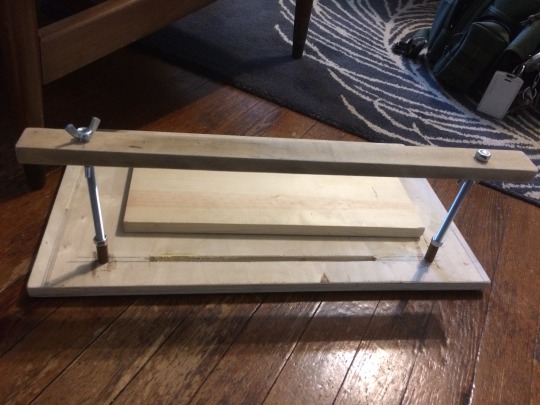
Step 1. Making bookbinding tools. I realized very quickly that I needed a sewing frame and a book press. If I were to order these things I would have spent anywhere from $150 – $500. Luckily my family likes to make things. So I enlisted my dad to help me make some simple tools. cost: $30 in materials and an afternoon.
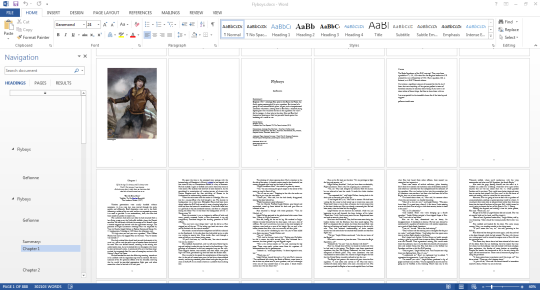
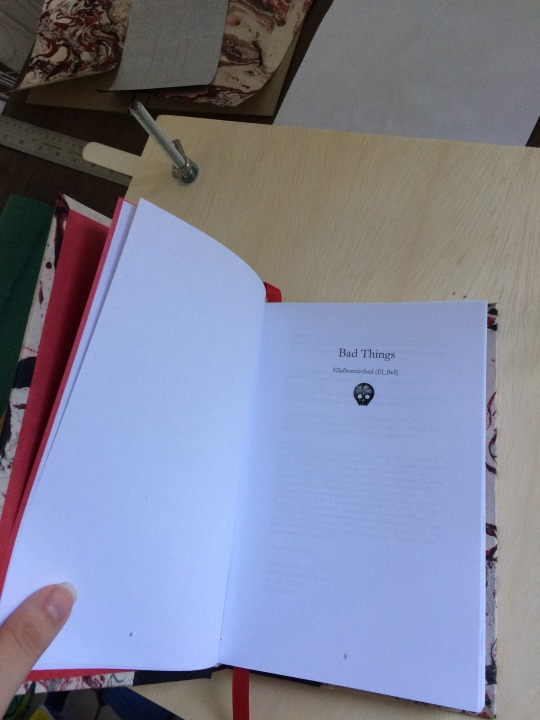
Step 2. Typesetting. Microsoft Word lets you print in “booklet” form, which allows you to create signatures from folded 8.5×11" paper. Each book takes a half to a full day to format.
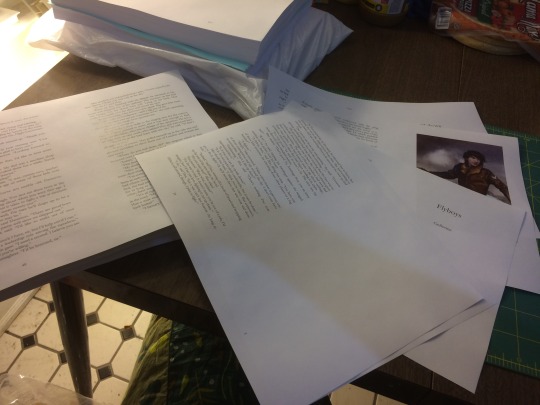
Step 3. Printing. I am lucky enough to have a robust color laser printer at my disposal. Lightweight 20lb bond / 75gsm copy paper is what I used. This isn’t ideal for books, but it’s inexpensive, easy to procure, and doesn’t choke the laster printer. Perhaps in the future I can do an edition on super thin Bible paper, if I can find a printer that will print on it.
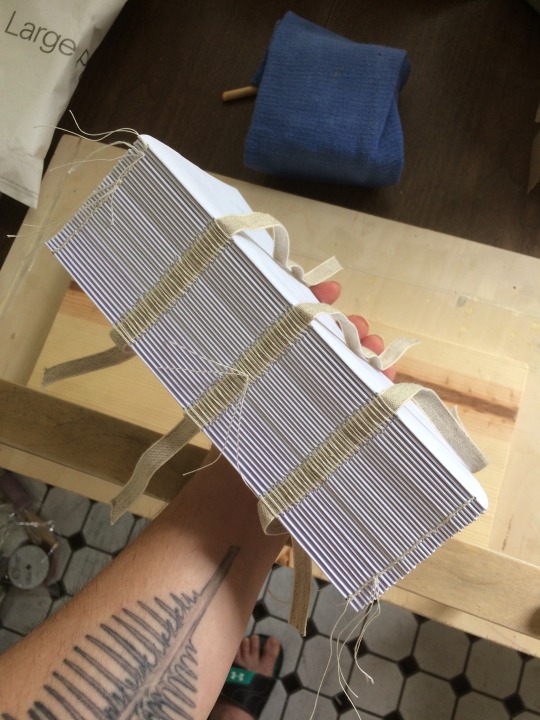
Step 4. Folding, Punching. Perhaps the most tedious part: Every sheet of paper must be folded individually. Then you assemble the signatures and use an awl to punch holes for sewing. Flyboys was 888 pages, which means 222 sheets of paper to fold.
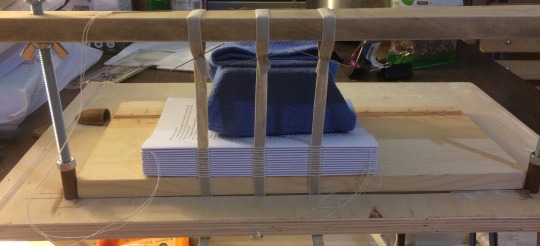
Step 5. Sewing the text block. Now it’s time for tool #1, the sewing frame. This worked exactly as designed, holding the linen tapes steady while I sewed around them. A brick in a rag serves as a weight to hold the text block down while sewing.
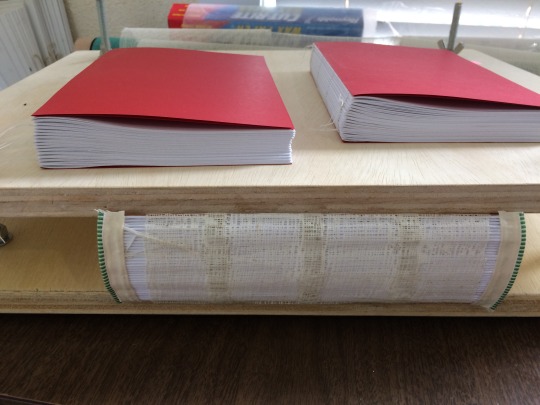
Step 5. Gluing. Once the text block is sewn, I glue the end papers to both sides. Then it goes into tool #2, the press, with the spine edge poking out. I glue the signatures together, then apply the headbands and mull as further reinforcement. I leave the book in the press overnight.
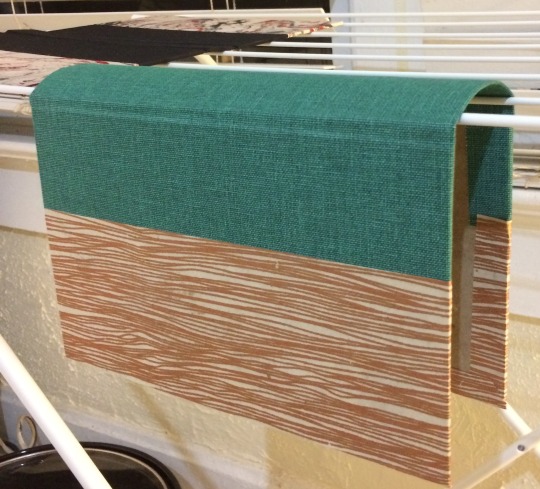
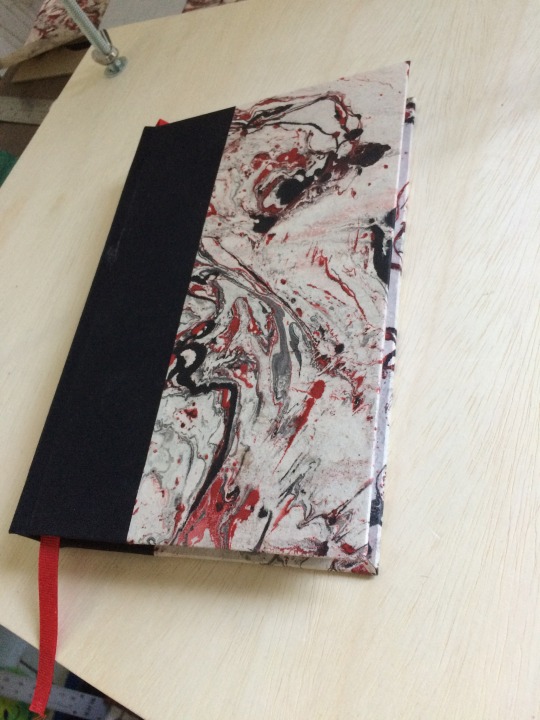
Step 6. Making the Case. The case or cover. I’m making half-bound cases, which means there is fabric on the spine, but the boards are covered in decorative paper.
For Flyboys, I went with a “Hux’s hair and verdigris” theme of green cloth, copper printed paper and copper endpapers.
For Bad Things, I wanted murderous blood spatters. I ended up with black cloth, black and red marbled paper and red metallic endpapers.
Step 7. Assembly. The most nerve-wracking step. This is where you glue the block to the case. One shot deal. If you do it crooked, the book is crooked forever. YIKES! After you glue it, you put it in the press overnight again.
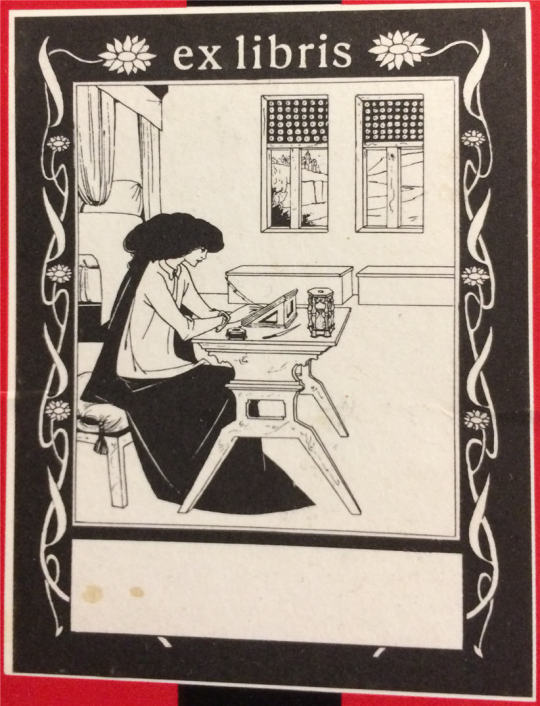
Step 8. Ex Libris. I have a few old ex libris labels with Aubrey Beardsley art, I think that’s an appropriate choice to pair with the queer and sexy, so I am adding them inside the front endpapers in the traditional spot. An ex libris label is a traditional way to signify who the book belongs to.
Step 9. Make author squeal with glee. My favorite step.
Again, these books are NOT FOR SALE.
Gods, it’s been an age since I did any bookbinding. It’s SO good to see somebody writing about doing a good job of it.
There’s a great book which I originally got from the library. I bought a copy by the time I returned it and left something extra for the next person who’d borrow it. I’d applied the techniques to a single signature booklet of instructions, of my own devising, for making a sewing frame.
Bind MY fics, friend!
Saving this for when I retire and can afford to bind the WOF books this way.






 Zynn's Exodus