Common wisdom has it that Tumblr is filled mostly with people in their teens and early twenties. I keep seeing people talk about being “older than the average” Tumblr user and naturally, that makes me curious to know, well, how old is the averageTumblr user, really? Fortunately, other people are interested in this, too, and have already done some surveys. This data comes from Google Doubleclick Ad Planner data that has been available to advertisers. It is from 2012, but it probably hasn’t changed significantly since then. This data came from the United States only, and the demographics may vary somewhat in other countries.
Tumblr skews toward the younger end of the social media world, but the average age of Tumblr users is actually 34.6 years old. This is only a little bit younger than the average age for social media users as a whole (36.9). The youngest Tumblr users (0-24) are about 30% of total, while the next two groups (25-44) look like added together they’re a bit over 40%. Another website breaks down the same Ad Planner age data a bit differently and shows that people over 35 are 47% of Tumblr users. (13-17=8%; 18-34=45%). Compared to Facebook, where 66% of users are over 35, Tumblr definitely has a younger set of users. The average age, however, is still around going to be around 34 years old. No matter how you slice it,Tumblr is younger than most other social media sites, but not as young as you might think it is.
In terms of gender, the surveys only gathered data on male and female.Tumblr has 62% women, a fairly higher amount of women than Facebook (57%). but not nearly as much as Pinterest or Blogger.
So, while it’s fair to say that Tumblr is a more “youthful” site than most other social media sites, the idea that the “average” Tumblr user is in the youngest age group is incorrect.
I’m extremely curious about all this and this is my first inquiry into the topic. I haven’t even looked into the academic literature yet. So this is sort of a first look. I’ll definitely post about it when I find a properly designed, peer reviewed and published survey on the matter.
I know discourse is the word of choice in fandom nowadays but I kind of wish we would have stuck with “fandom wank” because it carries the implication that the anger involved culminated into effectively nothing and that the act was wholeheartedly masturbatory in nature rather than for any greater cause.
I saw this post about an hour after I saw a post that said, essentially, “There should be a word for that thing where [exactly describes ‘squeeing’].”
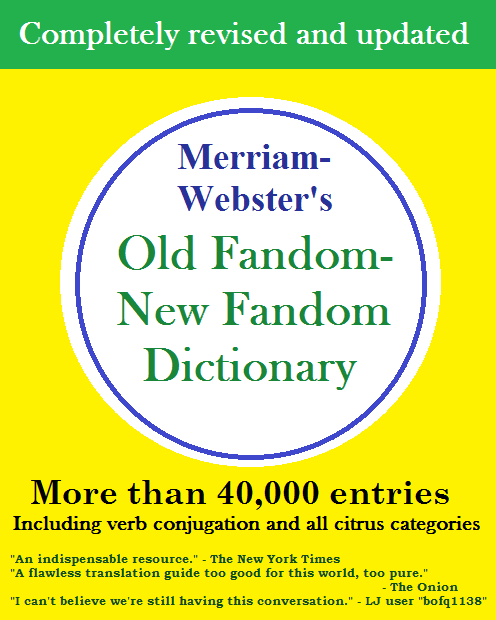
I feel like the time has come to produce something like this:
Squee: The noise you make when something is so good that all you can really do is squeak or squeal. A high pitched sound of delight, often accomanied by hugging yourself or others.
Squick: A fic/art/concept/topic that is repellent to you, so you reject association with it and instead retreat to your personal comfortable spaces- all the while remembering that someone else’s comfort is not your own.
YKINMKATO: Also called “kink tomato.” Abbreviation meaning “your kink is not my kink, and that’s okay.” Used to explain why you are rejecting art or fic brought to you by someone else. A solid mantra to recall instead of sending flames in people’s comments
Flames: The comment equivalent of anon hate.
AMV: “animated music video” or “anime music video.” Often, this is stylized to fit a specific fandom, such as a “PMV” (pony music video) in my little pony. May also be referred to as a lyricstuck.
Filk: Combination of the words “film” and “folk,” this is a music genre, to which “fan songs” and “fan parody covers” belong. If you don’t really understand what this means, take a quick listen to American Pie, then compare Weird Al Yankovic’s Saga Begins
BNF: Big name fan. You know that one person who is just so fuckign popular in your fandom? Their art is always on your dash, everyone knows their fics? Being spoken to directly by them is basically being noticed by everyone ever’s senpai? That’s what these people are called.
DL:DR; Not unliked the teal deer (tl;dr, or “too long, didn’t read”), DLDR means “don’t like? Don’t read!” It’s a reminder that you are under no obligation, ever, to expose yourself to uncomfortable (or, squicky), or potentially harmful (or, triggering), material. Not ever. If you don’t actively like something? It’s not worth your time. Skip it.
Gen: or “genfic” “genart” etc. Fan works which contain no or very little romantic content. Often these are styled after the canon material, and may be called “episodic” ro “slice of life” in addition.
Lemon: Work containing strong pornographic elements
Lime, or Citrus: Work containing mild or implicit pornographic elements
Sockpuppeting: The surprisingly common scenario of someone making a bunch of fake accounts/sideblogs to send themselves reviews or hate, to try to increase views or drama surrounding a work. The accounts they make are called Sockpuppets.
WAFF: Warm and fluffy feelings. A genre of fic that exists just to be therapeutically sweet. Nowadays, usually just called “fluffy.”
Schmoop: Take WAFF and somehow make it even more syrupy. You’ll know it when you see it.
Whump: Imagine if you will, a hurt-comfort fic. The comfort might be considered WAFF. The hurt? That’s the whump.
Wapanese: When white autors pepper their anime fanfic with random, tonally inappropriate japanese words.
Anthropomorfic: Nowadays we just call these “humanstuck” or “humanized AU.”
Wank: Wildly disproportionate drama that crops up because someone wrote/drew/did something that someone else didn’t like. Seriously, I cannot begin to express the fiascos that have come about from all this. Just… Just go look at this.
Plot bunny: Story ideas that you probably won’t ever actually deal with, but that multiply entirely out of control, creating huge worlds in your head that you’re probably not going to write. But hey! You might! And until then they make great sideblogs/askblogs/tumblr posts.
Casefic: Fanfics that try to create an episode-like feel for procedural and crime dramas, moster of the week shows, etc.
Jossed: When popular fan theories and fanon are addressed in the canon of a series, and whoops, turns out we were all very, very wrong.
Kripked: When popular fan theories and fanon are addressed in the canon of a show and, hot damn, we fucking called it.
Secret Masters: The people who run the websites/ communities/etc that we all do our fanning on. Less relevant now that we have things like tumblr, but when everyone had to run their own archival and social sites for each fandom, it was more important to pay our respects to the strange and powerful beings that brought us all together and gave us our fannish homes. Think the staff of AO3, for example.
Bashing: When a writer purposefully writes a specific character as a horrible, horrible person so that they can throw them out of the storyline, usually to allow their OTP to get together without trouble. Distinct from fridging in that it doesn’t require the character to die, but rather to be such a screaming harpy that they get rightfully removed from the main characters’ lives for being an abusive hell beast. Generally, a type of character hate. Be wary of people who bash women, queer people, and POC with consistency: they are not safe to be around.
‘Squick’ also has an alternate horrible meaning for Harry Potter fans who were in fandom a while back. Dear god.
Also:
Purple prose: Fic that is excessively flowery and complicated. Basically the “me, an intellectual” meme. If it has the phrase “cerulean orbs” you know it’s purple prose.
Beige prose: The opposite of purple prose. Basically, the plainest (and, if done wrongly, the most boring) type of prose.
R&R: Read & review. Back from when fic comments were called “reviews” and there was no such fucking thing as the kudos button.
I don’t know if it ever got used outside of one particular small fandom I was in, but I’ve always been fond of TFWIC: “the fuckwits in charge” aka the show writers. Who, as you may guess, consistently made frustrating writing decisions (and yet we kept coming back for more).
TPTB (“The Powers That Be”) can also refer collectively to the show’s creators (especially for shows that don’t have a single prominent creator or show runner) and/or the network/production execs overseeing the show. Example: “TPTB wouldn’t let Xena and Gabrielle be in lesbians with each other, but calling each other ‘soul mate’ was apparently fine.”
A man is driving down the road and breaks down near a monastery. He goes to the monastery, knocks on the door, and says, “My car broke down. Do you think I could stay the night?”
The monks graciously accept him, feed him dinner, even fix his car. As the man tries to fall asleep, he hears a strange sound.
The next morning, he asks the monks what the sound was, but they say, “We can’t tell you. You’re not a monk.”
The man is disappointed but thanks them anyway and goes about his merry way.
Some years later, the same man breaks down in front of the same monastery.
The monks accept him, feed him, even fix his car. That night, he hears the same strange noise that he had heard years earlier.
The next morning, he asks what it is, but the monks reply, “We can’t tell you. You’re not a monk.”
The man says, “All right, all right. I’m *dying* to know. If the only way I can find out what that sound was is to become a monk, how do I become a monk?”
The monks reply, “You must travel the earth and tell us how many blades of grass there are and the exact number of sand pebbles. When you find these numbers, you will become a monk.”
The man sets about his task. Forty-five years later, he returns and knocks on the door of the monastery. He says, “I have traveled the earth and have found what you have asked for. There are 145,236,284,232 blades of grass and 231,281,219,999,129,382 sand pebbles on the earth.”
The monks reply, “Congratulations. You are now a monk. We shall now show you the way to the sound.”
The monks lead the man to a wooden door, where the head monk says, “The sound is right behind that door.”
The man reaches for the knob, but the door is locked. He says, “Real funny. May I have the key?”
The monks give him the key, and he opens the door.
Behind the wooden door is another door made of stone.
The man demands the key to the stone door.
The monks give him the key, and he opens it, only to find a door made of ruby.
He demands another key from the monks, who provide it.
Behind that door is another door, this one made of sapphire.
So it went until the man had gone through doors of emerald, silver, topaz, and amethyst.
Finally, the monks say, “This is the last key to the last door.”
The man is relieved to no end.
He unlocks the door, turns the knob, and behind that door he is amazed to find the source of that strange sound.
But I can’t tell you what it is because you’re not a monk
the way i learned this, it was always told through spoken word. And you’d do the door thing for ages. AGES. literally just making up any old material. ‘behind the foam door is a door made of spinach’ that kind of shit. Go on until whoever is listening has already begged you to stop and has now gone on to pleading, clutching your shirt on their knees pleading. And when you finally said the last line? People went fucking nuts Like there was a good chance of just getting the teeth knocked out of you after telling that joke.
A friend of mine did that shit for 30 minutes on a camp once. The entire fucking bus just exploded in anger when she finished. It was a fucking massacre.
People in the Middle Ages valued sweet smelling breath and bodies, seeing them as desirable, so there is a great deal of evidence from the period of tooth pastes, powders and deodorants.
Contrary to the typical Hollywood depiction of medieval peasants with blackened and rotting teeth, the average person had teeth which were in fairly good condition, mainly due to the rarity of sugar in the diet. Most medieval people could not afford sugar and those who could used it sparingly.
Archaeological data shows that only 20% of teeth had signs of decay, as opposed to 90% in the early twentieth century. The main dental problem for medieval people was not decay but wear, due to a high content of grit in the main staple, bread.
For deodorants, soap was available for the wealthy, but a variety of herbs and other preparations were also used. Soapwort is a plant native to Europe and Asia which, when soaked in water, produces an effective liquid soap. Mint, cloves and thyme were also extensively used by simply rubbing into the skin, and alum (hydrated potassium aluminium sulphate) was an effective deodorant.
I am trying to keep to 14th century technology on my pilgrimage to Canterbury, which gives me various options when looking at hygiene. In the middle ages people generally cleaned their teeth by rubbing them and their gums with a rough linen cloth, or the chewed end of a stick. There are various recipes for pastes and powders that could be put on the cloth to help clean the teeth, but I have chosen simple salt to whiten them and to aid fresh breath. I will also be using the stick method, and will be taking along a supply of liquorice root sticks for that purpose.
I also have a few blocks of alum, which when rubbed into wet skin has a deodorising effect. Alum, like beeswax, was used extensively in the middle ages for a variety of purposes, also being useful:
* in the purification of drinking water as a flocculant * as a styptic to stop bleeding from minor cuts * as a pickling agent to help keep pickles crisp * as a flame retardant * as an ingredient in modelling clay * as an ingredient in cosmetics and skin whiteners * as an ingredient in some brands of toothpaste
The photograph shows my wash kit including home made olive oil soap, salt for the teeth, a block of deodorising alum, cloves, a boxwood comb made for me by Peter Crossman of Crossman Crafts and some liquorice root sticks, all on a woollen ‘towel’. Note that the cloves are kept in a ventilated box….this is because insects hate the smell of cloves and so a perforated box will keep them out of my kit and food bag when I am sleeping rough. TIP: If you steep some cloves to obtain the oil and put the liquid around the doors and windows of your house, it keeps spiders and insects out.
Pay attention medieval-ish fantasy authors- filthy people without any cleaning or self care is Not Historical.
People who are blind from birth will gesture when they speak. I always like pointing out this fact when I teach classes on gesture, because it gives us an an interesting perspective on how we learn and use gestures. Until now I’ve mostly cited a 1998 paper from Jana Iverson and Susan Goldin-Meadow that analysed the gestures and speech of young blind people. Not only do blind people gesture, but the frequency and types of gestures they use does not appear to differ greatly from how sighted people gesture. If people learn gesture without ever seeing a gesture (and, most likely, never being shown), then there must be something about learning a language that means you get gestures as a bonus.
Blind people will even gesture when talking to other blind people, and sighted people will gesture when speaking on the phone – so we know that people don’t only gesture when they speak to someone who can see their gestures.
Earlier this year a new paper came out that adds to this story. Şeyda Özçalışkan, Ché Lucero and Susan Goldin-Meadow looked at the gestures of blind speakers of Turkish and English, to see if the *way* they gestured was different to sighted speakers of those languages. Some of the sighted speakers were blindfolded and others left able to see their conversation partner.
Turkish and English were chosen, because it has already been established that speakers of those languages consistently gesture differently when talking about videos of items moving. English speakers will be more likely to show the manner (e.g. ‘rolling’ or bouncing’) and trajectory (e.g. ‘left to right’, ‘downwards’) together in one gesture, and Turkish speakers will show these features as two separate gestures. This reflects the fact that English ‘roll down’ is one verbal clause, while in Turkish the equivalent would be yuvarlanarak iniyor, which translates as two verbs ‘rolling descending’.
Since we know that blind people do gesture, Özçalışkan’s team wanted to figure out if they gestured like other speakers of their language. Did the blind Turkish speakers separate the manner and trajectory of their gestures like their verbs? Did English speakers combine them? Of course, the standard methodology of showing videos wouldn’t work with blind participants, so the researchers built three dimensional models of events for people to feel before they discussed them.
The results showed that blind Turkish speakers gesture like their sighted counterparts, and the same for English speakers. All Turkish speakers gestured significantly differently from all English speakers, regardless of sightedness. This means that these particular gestural patterns are something that’s deeply linked to the grammatical properties of a language, and not something that we learn from looking at other speakers.
References
Jana M. Iverson & Susan Goldin-Meadow. 1998. Why people gesture when they speak. Nature, 396(6708), 228-228.
Şeyda Özçalışkan, Ché Lucero and Susan Goldin-Meadow. 2016. Is Seeing Gesture Necessary to Gesture
Like a Native Speaker? Psychological Science
27(5) 737–747.
Asli Ozyurek & Sotaro Kita. 1999. Expressing manner and path in English and Turkish:
Differences in speech, gesture, and conceptualization. In Twenty-first Annual Conference of the Cognitive Science Society (pp. 507-512). Erlbaum.
So a scathing article on the fetishization of gay men by white women stumbled into my feed and I got pissed.
Rather than argue that there is no fetishization, I’m simply going to list a few of the reasons why I ship gay ships. Which – shock, horror – are nothing like what you’re suggesting, and paint a far richer picture than your eagerness to jump on your high horse and ‘burn the hypocrite’ would suggest.
I ship gay ships because I’m sick of reading heterosexual romance with all its sexist stereotypes. Not including the het traits prevalent in yaoi, slash fiction focuses on the relationship between two personalities rather than the reinforcement of two gender roles or, even worse, the attempt at being edgy and feminist by doing nothing more than reversing those gender roles. Slash and Femmeslash – yes, believe it or not we can read both – as they exist today have been molded by significantly different tropes and practices, and are therefore refreshingly free of those stereotypes that quite simply make me gag.
I ship gay ships because I don’t give a fuck about their gender. I don’t go out in search of a new ship by scrolling to find which two men I can fetishize next. I latch onto chemistry that often happens to be in the form of a bromance. Why is it always a bromance instead of a female friendship? Because female friendships of depth are still underrepresented in pop culture. Maybe you should write an article about that.
This brings me to my next point. Extending a bromance into a romance, to me, is the figurative equivalent of shoving a sword through the “no-homo” attitude that I see far too often. Just like my first point, this is a way of using slash fiction to counter sexism: male sexism. No homo? Full fucking homo. Get over it. I want to see more of it, not because it gets me off, but because it normalizes the natural extension of a male friendship into a gay romance, rather than reinforcing the concept that men should act as homo as they like but then get weirded out when love is brought into the mix.
Finally, slash fiction removes the vicarious appeal, and I like that. This is not the sort of romance that I’m meant to mentally slot myself into and then spend the rest of my life searching for, only to feel hideously incomplete if it doesn’t show. This is a romance experienced by two people who are not me. There is no ‘relateable female protagonist’ who I’m meant to model myself off, which means I am free to appreciate their happiness for them. Do you understand what I’m saying here? Because this is the most powerful point and the one that is most difficult to articulate. Slash fiction teaches me to appreciate the happiness of others, without then hinging my own happiness upon it. It teaches me that there can be just as much joy in playing the role of the Pansy or the Hermione who set up the two dorks, as there is in being the romantic heroine. It teaches me to appreciate the love that other people share without experiencing jealousy or aggression, which teaches me to be relaxed and happy in my own skin, and to value myself by qualities far removed from whether I’m single or taken.
Since you’ve stuck with me to the end, I actually am going to argue against the concept that the fetishization of lesbian porn by men is the same as the love of gay ships by women. It’s not. Women support gay romance in fiction to the same extent that they support it in real life. The issue that can arise with men supporting lesbian porn is that they often don’t also support those relationships as they exist in the real world.
Women read gay romance because it’s liberating. It squashes stereotypes and sexism, and allows us to read a romance that for once in our fucking lives does not require us to be either the damsel or the femme fatale.
We read it because gender and gender roles shouldn’t matter when it comes to romance, and if the only way we can get that is through unpublished, amateur fiction, then maybe you could throw us a goddamn bone and think twice before devaluing the richness that is slash fiction by reducing gay romance to a fetish.
Something that had already caught my attention when I first watched Captain America: Civil War, and that now receives my full love, is the scene at the end of the movie when Steve says “I can do this all day” once Tony tells him to surrender. While it is cool in itself that it mirrors skinny Steve from the 1940s, it is cooler to me for another reason.
As soon as Steve says “I can do this all day”, a heavily beaten Bucky lying on the floor, and devoid of his metal arm reaches for Tony’s leg, to stop him from hitting Steve. This mirrors the real Bucky, the guy who befriended Steve when both were children, the guy who always got Steve’s back, who didn’t care about Captain America but for the little guy from Brooklyn who was too dumb to run from a fight.
To me that’s the crucial Bucky moment of the whole movie. That’s the moment when you know why Steve is fighting for Bucky. Inside of that broken, pretty dehumanised man, is still that kid from Brooklyn who couldn’t bare to see his best friend hurting.
The follow up of the “I can do this all day” scene in Captain America: the First Avenger is this:
They did go to the future. Yes, things changed and both of them changed, but at the same time they are still the same. The tiny, skinny, sickly kid who would never run from a fight, and his best friend, who would be with him till the end of the line.
Some time ago there was a post on my dashboard saying that the Captain America trilogy is beautifully symmetric, for Steve Rogers picked up the shield for Bucky and gave the shield up for Bucky, becoming Captain America and retiring from that position because of his friend. But to me that’s not it.
To me this trilogy is beautifully symmetric because of those two mirroring scenes I talked about above. Because Steve Rogers can expend his whole day, not to say his whole life, fighting for what he believes is right, and Bucky Barnes will always get his back, till the end of the line. Be it in the 1940s or the 21st century.
Captain America is Steve Rogers. A shield doesn’t make him. Being able to “do this all day” is what makes Captain America, be it in the past or in the future. From beginning to end Steve Rogers is not a perfect soldier, but a good man. At the same time, Bucky Barnes is not what Hydra made of him, what it made him do. He isn’t just a perfect soldier. Inside the perfect soldier “ready to comply” has always been trapped a good man.
Gather round, children. Auntie Jules has a degree in psychology with a specialization in social psychology, and she doesn’t get to use it much these days, so she’s going to spread some knowledge.
We love saying representation matters. And we love pointing to people who belong to social minorities being encouraged by positive representation as the reason why it matters. And I’m here to tell you that they are only a part of why it matters.
The bigger part is schema.
Now a schema is just a fancy term for your brain’s autocomplete function. Basically, you’ve seen a certain pattern enough times that your brain completes the equation even when you have incomplete information.
One of the ways we learned about this was professional chess players vs. people who had no experience with chess.
If you take a chess board and you set it up according to a pattern that is common in chess playing (I’m one of those people who knows jack shit about chess), and you show it to both groups of people, and then you knock all the pieces off the board, the pro chess players will be able to return it to its prior state almost perfectly with no trouble, because they looked at it and they said, “Oh, this is the fifth move of XYZ Strategy, so these pieces would be here.”
The people who don’t know about chess are like, “Uh, I think one of the horses was over here, and maybe there was a castle over there?”
BUT, if you just put the pieces randomly on the board before you showed it to them, then the amateurs were more likely to have a higher rate of accuracy in returning the pieces to the board, because the pros are SO entrenched in their knowledge of strategy patterns that it impairs their ability to see what is actually there if it doesn’t match a pattern they already know.
Now some of y’all are smart enough to see where this is going already but hang on because I’m never gonna get to be a college professor so let me get my lecture on for a second.
Let’s say for a second that every movie and TV show on television ever shows black men who dress in loose white T-shirts and baggy pants as carrying guns 90% of the time, and when they get mad, they pull that gun out and wave it in some poor white woman’s face. I mean, sounds fake, right? But go with it.
Now let’s say that you’re out walking around in real life, and you see a black man wearing a white T-shirt and loose-fitting jeans.
And let’s say he reaches for something in his pocket.
And let’s say you can’t see what he’s reaching for. Maybe it’s his wallet. Maybe it’s his cell phone or car keys. Maybe it’s a bag of Skittles.
But on TV and movies, every single time a black man in comfortable, casual clothes reaches for something you can’t see, it turns out to be a gun.
So you see this.
And your brain screams “GUN!!!” before he even comes up with anything. And chances are even if you SEE the cell phone, your brain will still think “GUN!!!” until he does something like put it up to his ear. (Unless you see the pattern of non-threatening black men more often than you see the narrative of them as a threat, in which case, the pattern you see more often will more likely take precedence in this situation.)
Do you see what I’m saying?
I’m saying that your brain is Google’s autocomplete for forms, and that if you type something into it enough, that is going to be what the function suggests to you as soon as you even click anywhere near a box in a form.
And our brains functioning this way has been a GREAT advantage for us as a species, because it means we learn. It means that we don’t have to think about things all the way through all the time. It saves us time in deciding how to react to something because the cues are already coded into our subconscious and we don’t have to process them consciously before we decide how to act.
But it also gets us into trouble. Did you know that people are more likely to take someone seriously if they’re wearing a white coat, like the kind medical doctors wear, or if they’re carrying a clipboard? Seriously, just those two visual cues, and someone is already on their way to believing what you tell them unless you break the script entirely and tell them something that goes against an even more deeply ingrained schema.
So what I’m saying is, representation is important, visibility is important, because it will eventually change the dominant schemas. It takes consistency, and it takes time, but eventually, the dominant narrative will change the dominant schema in people’s minds.
It’s why when everyone was complaining that same-sex marriage being legal wouldn’t really change anything for LGB people who weren’t in relationships, some people kept yelling that it was going to make a huge difference, over time, because it would contribute to the visibility of a narrative in which our relationships were normalized, not stigmatized. It would contribute to changing people’s schemas, and that would go a long way toward changing what they see as acceptable, as normal, and as a foregone conclusion.
So in conclusion: Representation is hugely important, because it’s probably one of the single biggest ways to change people’s behavior, by changing their subconscious perception.
(It is also why a 24-hour news cycle with emphasis on deconstructing every. single. moment. of violent crimes is SUCH A TERRIBLE SOCIETAL INFLUENCE, but that is a rant for another post.)