ofwitchesandwolves:

Y’all asked for it so y’all gonna get it! I’mma start off with the barebones essentials and work my way to basic definitions. Sit down on something comfy and get yourself your warm beverage of choice and maybe grab a notebook because here goes.

What are runes?

Runic alphabets have been around since about 150 AD and used as a writing system by a lot of Germanic languages. These systems were eventually phased out, slowly but surely, with the progressive Christianisation that started around 700-1100 AD. The three most commonly known (and used?) Are the Elder Futhark, the Younger Futhark and Futhorc.

Runes aren’t, themselves, broadly meant for divination, thought there are a few passages in the Eddas that mention Odin “finding” and using them.

Alright, so which alphabet should I use?

Whichever one you want! I prefer using the Elder Futhark, because it’s the first alphabet I learned and got familiar with, but that doesn’t at all stop you from using the Younger Futhark or Futhorc. I’d heavily suggest making sure you read up on the differences in each alphabet though; Ansuz, for example, won’t look the same, mean the same or even be called the same from one alphabet to another. 

Familiarize yourself with each of them if you want/can, and choose based on your own preferences and criteria. Always work with what feels best for you!

But I’m not really familiar with Germanic traditions / I’m a baby witch, should or can I use runes for divination?

This is the concept that got my goat real good the first time. You do not, in any way, shape or form, need to be experienced to cast runes. This is a notion that is outdated and perpetuated by gatekeepers and exclusionists. No one gives a flying flip how long you’ve been practicing witchcraft, or if you even practice at all!

Divination should be seen as a tool to further yourself and/or your craft. It can be used by itself or in conjunction with other activities, practices or beliefs. I was 15 when I started learning about runes (dear god that was literally over ten years ago) and I had no idea what I was doing back then. I read up as much as I could about the system I was wanting to use and, once I was comfortable with it, I started doing small readings.

It shouldn’t matter how new or familiar you are to divination, rune casting or Germanic traditions. If rune casting feels right to you, you are more than free to use whatever divination method feels right to you.

What should I do before I start a reading?

As a Norse Pagan, I usually invoke my patron deities (Baldr and Loki, in this case), as well as Odin and Freyja, sometimes Gullveig/Heiðr because reasons. I have no idea whether or not this has any actual bearing on the reading itself, as mine were as accurate before I converted as they are now.

Making sure you’re in a quiet and/or comfortable space is also a good idea, even if that just means popping in some earphones and listening to something that makes you focus and feel calm.

This is also a good time to mention that cleansing your runes (stone, bone, wood or otherwise) is a very good idea. I typically do this with candles, incense, a bowl of water and a point of quartz for each element. I don’t do this nearly as often as I probably should, since most people suggest cleansing them after each reading… but, whatever, being lax with that hasn’t bitten me in the ass so far. So if you’re a spoonie, don’t worry: cleanse your runes when you feel they need to be cleansed, and that’s it.

Alright, I think I’m ready; how do I start reading?

Let me start by saying that the bullshit about never reading yourself? It’s just that. Bullshit. Do readings on yourself if you want to. Who the hell is going to stop you. Do whatever you want.

On that note, there are a few ways to cast runes, though these probably aren’t close to being the only ones: 

  • Intuitively choosing the stones
    Lay the runes down on a flat surface and let your hand hover over them and pick out the ones that feel right. You can either pick them in order of the spread you’re using, or place the runes where you feel they belong on the spread.
  • Throwing the stones
    Make sure you have a large flat surface to work with (preferably the floor honestly) where you won’t drop, scatter or lose a rune. You can use a mat underneath, and read the stones that fall on the corresponding positions in the spread or circle. (You can find many of these with a quick google search, or make your own mat!) Otherwise, you can take the first stones you see facing up and lay those out according to your spread.
  • Picking them blindly
    Either you or the person you’re reading pull stones blinding out of a pouch, bag or other container, and lay them out according to the spread you’re using. Pretty straightforward.

If you can think of another method, literally nothing is stopping you from using that instead. The runes are acting as a universal translator for whatever it is you’re tapping into. They’re just a tool to receive a message. How you choose to receive that message is completely up to you!

So I’ve got my runes laid out, now what?

Now comes the fun part. I can only really give you a good run-down of the Elder Futhark, and though it’s a good starting point, I would highly advise you do your own research on whatever alphabet you want to use. Wikipedia is a great place to start, but don’t stop there: look at several different websites and lists and compare. Combine and condense the information for yourself, and get to learn the definitions and meanings for yourself!

  • ᚠ Fehu • catle
    wealth, money, hard work paying off, can represent spiritual wealth
    reversed: effort gone to waste, natural and/or financial loss, greed
  • ᚢ Uruz • ox
    physical strength and speed, great energy, courage, masculine
    reversed: physical weakness, illness, violence, misdirected aggression
  • ᚦ Thurisaz • thor
    reactive, destructive and/or defensive force, tendency towards change
    reversed: dangerous compulsions, betrayal and malice, lies, spite
  • ᚨ Ansuz • of the Æsir 
    revelations, intuition, signs and signals, wisdom, power of words/names
    reversed: misunderstandings, delusions and vanity
  • ᚱ Raido

    • chariot
    physical/spiritual journeys, transition, seeing the bigger picture
    reversed: crisis, maybe due to stagnation, unwanted disruption

  • ᚲ Kaunan

    • torch
    creativity and inspiration, power of transformation, power of life
    reversed: instability, lack of creativity, false hope revealed, disillusionment

  • ᚷ Gebo

    • gift
    gifts in the form of sacrifice or generosity, contracts, partnerships
    reversed/opposed: greed, isolation and dependence, over-sacrifice

  • ᚹ Wunjo

    • joy
    comfort, pleasure, companionship, possibility of going over the top
    reversed: sorrow and alienation, growing distance, raging frenzy

  • ᚺ Hagalaz

    • hail
    wrath of nature, destruction for the sake of creation, natural order
    reversed: natural disasters, powerlessness, suffering

  • ᚾ Naudiz

    • need
    strength/growth from hardships, survival, determination
    reversed: deprivation and emotional starvation, constraints/restraints

  • ᛁ Isaz

    • ice
    challenges and frustration, psychological block, anticipation
    reversed/opposed: can oppose other runes with malice and treachery 

  • ᛃ Jera

    • good year
    hard work is fruitful, peace, happiness and relief, breaking the cycle
    reversed: sudden setbacks and bad timing

  • ᛈ Pertho

    • vagina
    secrets, mysteries, undiscovered abilities, choosing your own path
    reversed: stagnation, isolation and loneliness

  • ᛇ E/ihwaz

    • yew tree
    strength, stability, endurance, trustworthiness, your goal is realistic
    reversed: confusion, dissatisfaction and weakness of the mind

  • ᛉ Algiz

    • elk
    shield, the instinct to protect yourself/others, connection to the gods
    reversed: hidden dangers, loss of link to the divine, turning away

  • ᛊ Suwilo

    • the sun
    success and goals achieved, you have the power you need to succeed
    reversed/opposed: deception, false goals, gullibility, divine wrath

  • ᛏ Tiwaz

    • tyr
    honour and leadership, authority, success in competitions
    reversed: artistic block, over-analysis and sacrifice, imbalance/conflict

  • ᛒ Berkana

    • birch tree
    fertility in a broad sense, personal/physical growth, new beginnings
    reversed: family/relationship issues, anxiety over loved ones, abandon

  • ᛖ Ehwaz

    • horse
    steady and gradual progress, teamwork/loyalty, relationships
    reversed: reckless haste and its consequences, restlessness

  • ᛗ Mannaz

    • mankind
    the self, the human race, your attitude toward others and vice-versa, social awareness, altruism
    reversed: mortality, self-deception, cunning and manipulation

  • ᛚ Laguz

    • water
    literal/metaphorical flow, imagination, the unknown, chance of loss
    reversed: confusion/uncertainty, may be making the wrong choice

  • ᛝ Ingwaz

    • probably freyr
    warmth and love in general, tying loose ends, relief, freedom to move
    reversed: moving without change, fruitless effort, helpelessness

  • ᛞ Dagaz

    • dawn
    breakthroughs and clarity, security, power to change and grow, the ideal
    reversed/opposed: endings and coming round full circle

  • ᛟ Othila

    • inheritance
    ancestral property, what is most important, spiritual heritage and safety
    reversed: slavery, homelessness, bad karma, what one is unwillingly bound to

Phew! What a list. These are just brief descriptions and meanings that I’ve been able to compile and condense over the years.

But, what does “opposed” mean?

I see where you’re coming from. As a baby diviner, I, also, was confused by this. But let me explain how I’ve come to understand it! 

Sometimes, if you’re doing a set spread, you’ll have a spot for things like, “what will oppose you”, or “what you need to avoid”. Things like that. If, say, a rune like Suwilo was found in something like that, you’d want to try and keep a sharp mind to avoid deceptions or letting yourself be too gullible.

When runes don’t have a reversed form, their position in your spread will usually determine what they mean. (Though really this is true for literally any rune.)

Anything else I should know?

The best advice I can ever give anyone is to always do what you feel is right. If you find yourself wondering, “Should I do this? Is this right?” If you question yourself at all, you should probably not to the thing and go with something else.

It’s also important to mention that the names I have for the runes may not be the ones that you’ve learned to know them by; a lot of runes can go by different names depending on who you ask and where you look. Do your research, and know the runes by the names you feel are best! (And preferably historically accurate.)

As always, if you have any questions regarding runes and how to read them, please ask me! My ask box is literally always open and almost always empty.

ᚺᛖᛁᛚᛚ ∙ ᛟᚲ ∙ ᛋᛇᛚᛚ
Fanfic: Collector’s Edition

plaidadder:

saathiray:

noctumsolis:

armoredsuperheavy:

I’ve always loved collecting books. I’ve got enough books that my friends make jokes about using stacks of books as furniture – not true, but close enough.  But there is one type of book that I’ve never been able to get my hands on: fanfiction and other independently written, underground work. Especially work with queer themes and/or erotica.

It’s frustrating that fanfiction isn’t generally publishable or sellable. It’s a shame that creators could spend months or years laboring over a phenomenal piece of work and never see a dime for it, never see it in print. So I finally hit on an idea, an attempt to thank the authors of these wonderful underground works, without wandering into legality issues.  I decided to learn how to make books. These books are not for sale and are gifts to the authors.

So I have been working on this for a couple of months and here are the first results. These are the very first books I have bound.

My guinea pigs:

Flyboys by @gefionne
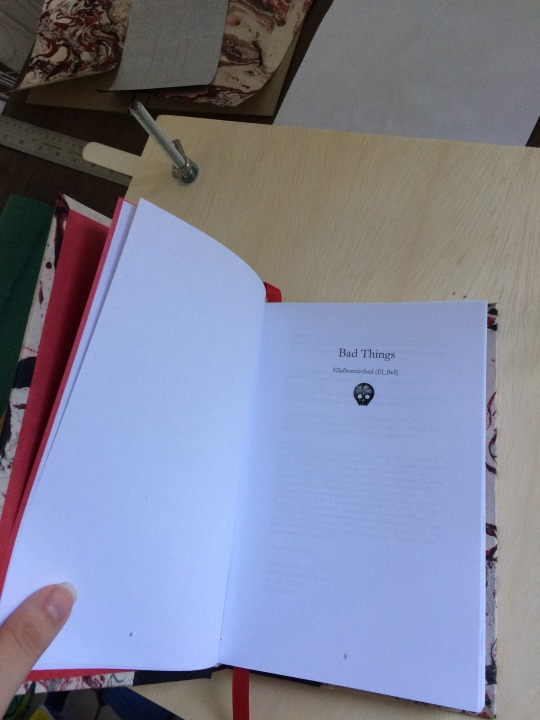
Bad Things by @ellabesmirched

Step 1. Making bookbinding tools.  
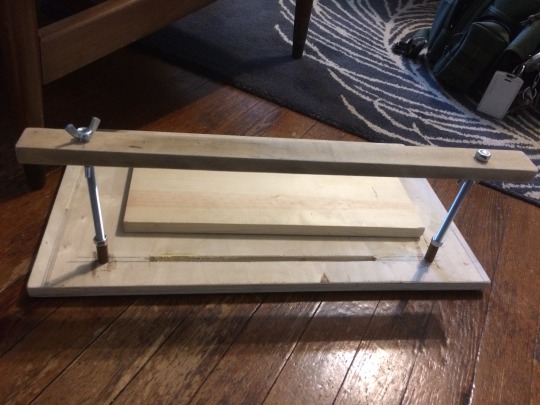
I realized very quickly that I needed a sewing frame and a book press. If I were to order these things I would have spent anywhere from $150 – $500. Luckily my family likes to make things. So I enlisted my dad to help me make some simple tools. cost: $30 in materials and an afternoon.

Step 2. Typesetting.
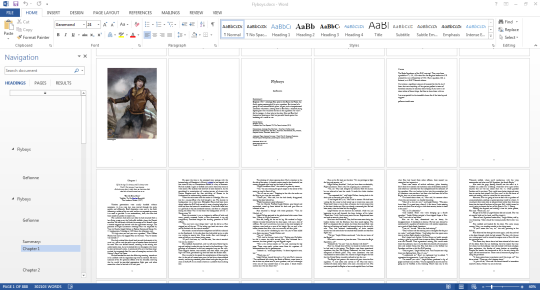
Microsoft Word lets you print in “booklet” form, which allows you to create signatures from folded 8.5×11" paper.
Each book takes a half to a full day to format.

Step 3. Printing.
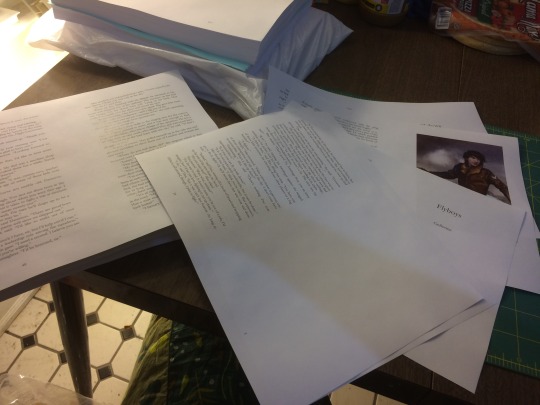
I am lucky enough to have a robust color laser printer at my disposal. Lightweight 20lb bond / 75gsm copy paper is what I used. This isn’t ideal for books, but it’s inexpensive, easy to procure, and doesn’t choke the laster printer.
Perhaps in the future I can do an edition on super thin Bible paper, if I can find a printer that will print on it.

Step 4. Folding, Punching.
Perhaps the most tedious part: Every sheet of paper must be folded individually. Then you assemble the signatures and use an awl to punch holes for sewing.  Flyboys was 888 pages, which means 222 sheets of paper to fold.

Step 5. Sewing the text block.
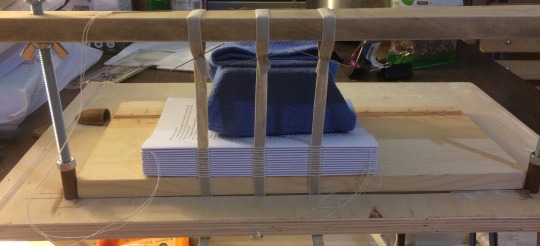
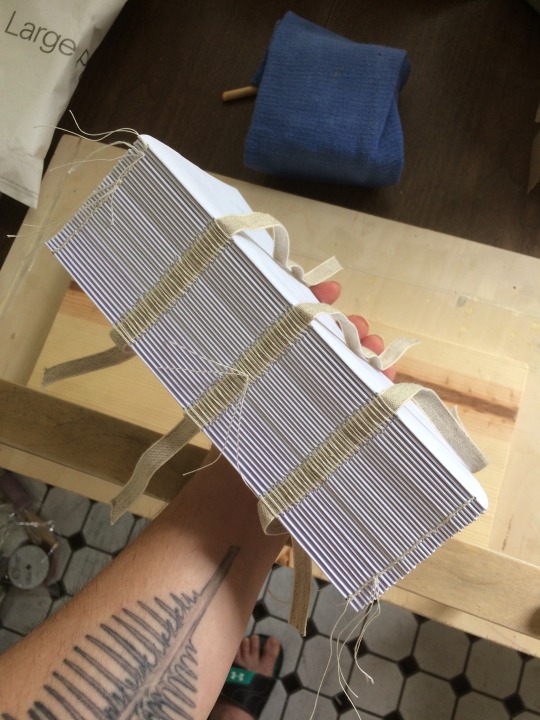
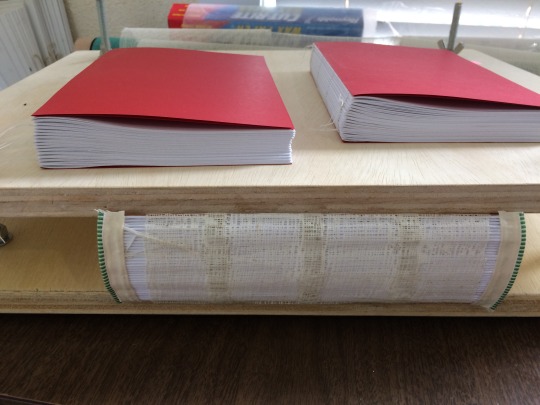
Now it’s time for tool #1, the sewing frame. This worked exactly as designed, holding the linen tapes steady while I sewed around them. A brick in a rag serves as a weight to hold the text block down while sewing.

Step 5. Gluing.
Once the text block is sewn, I glue the end papers to both sides. Then it goes into tool #2, the press, with the spine edge poking out. I glue the signatures together, then apply the headbands and mull as further reinforcement. I leave the book in the press overnight.

Step 6. Making the Case.
The case or cover. I’m making half-bound cases, which means there is fabric on the spine, but the boards are covered in decorative paper.

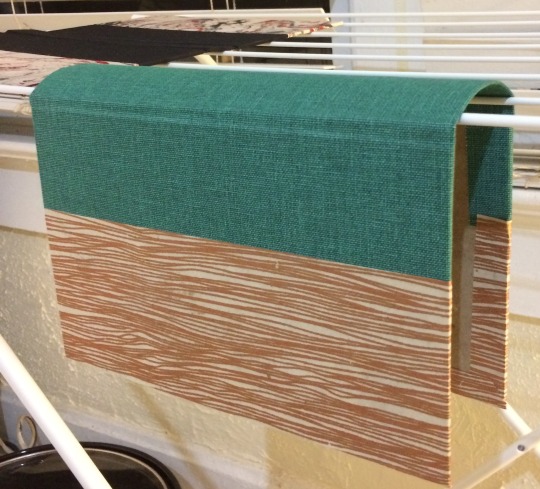
For Flyboys, I went with a “Hux’s hair and verdigris” theme of green cloth, copper printed paper and copper endpapers.

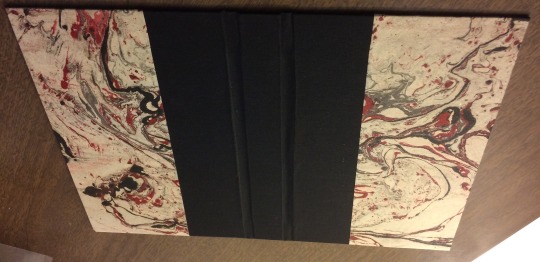
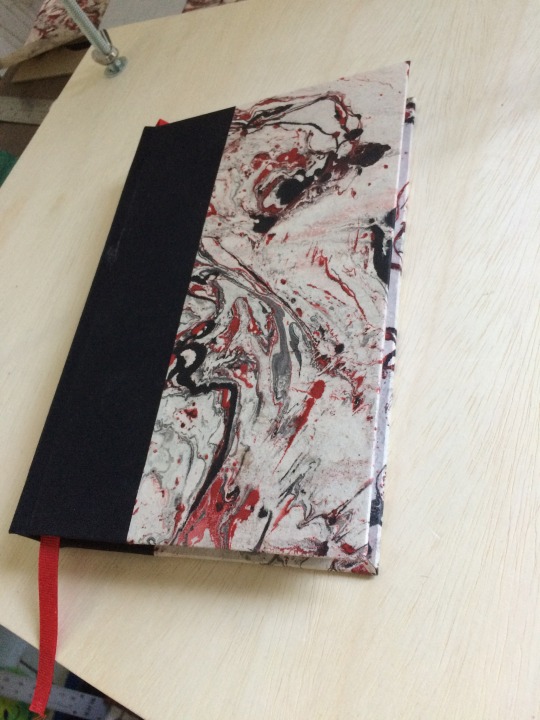
For Bad Things, I wanted murderous blood spatters. I ended up with black cloth, black and red marbled paper and red metallic endpapers.

Step 7. Assembly.
The most nerve-wracking step. This is where you glue the block to the case. One shot deal. If you do it crooked, the book is crooked forever. YIKES!
After you glue it, you put it in the press overnight again.

Step 8. Ex Libris.
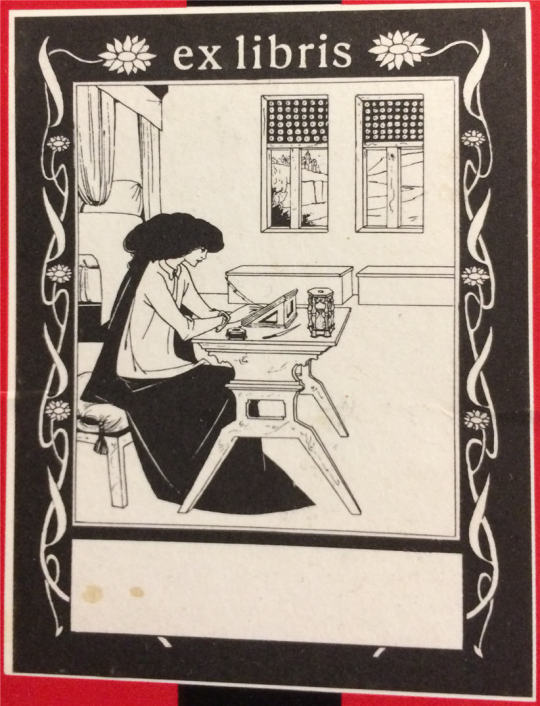
I have a few old ex libris labels with Aubrey Beardsley art, I think that’s an appropriate choice to pair with the queer and sexy, so I am adding them inside the front endpapers in the traditional spot. An ex libris label is a traditional way to signify who the book belongs to.

Step 9. Make author squeal with glee.
My favorite step.

Again, these books are NOT FOR SALE.

Gods, it’s been an age since I did any bookbinding. It’s SO good to see somebody writing about doing a good job of it.

There’s a great book which I originally got from the library. I bought a copy by the time I returned it and left something extra for the next person who’d borrow it. I’d applied the techniques to a single signature booklet of instructions, of my own devising, for making a sewing frame.

Bind MY fics, friend!

Saving this for when I retire and can afford to bind the WOF books this way.

simonalkenmayer:

scifrey:

gaslightgallows:

not-rude-ginger:

lightrises:

jebiwonkenobi:

Once upon a time I worked in this little burger/coffee/ice cream shop and a lady came in one winter and asked if we had a caramel apple drink and we were like ‘well we have cider’ and she was like ‘no I don’t remember what it’s called but this place made a drink that was chai tea, apple cider, and caramel’ and Breezy offered to try and make something for her but she changed her mind and left so Breezy and I were like ‘alright let’s try this’ because we had chai tea, instant cider mix, a shit ton of caramel, instant hot water from the espresso and too much free time. 

And let me tell you it was delightful. It tastes like watching the leaves changing color and dancing in the wind. It tastes like picking out pumpkins and gourds and fresh apples at the farm up north. It tastes like witches and freedom.

I make it every year now and this year I walked in the house on the morning of October first with all the ingredients and shouted ‘FALL DRINK’ and my roommates were like ‘????’ so I made them Fall Drink and now every time they get home from work they’re like ‘Fall Drink pls?????’

Anyway I remember literally nothing else about that woman but I’m very grateful to her. 

for anyone wondering about proportions/etc here’s op’s answer from the repiles:

@gaslightgallows I feel this would be relevant to your interests. 

I don’t like caramel but I can vouch for hot chaider being amazing.

Deareat @simonalkenmayer I feel like this is relevant to your interests.

Also, I do something like this in the crock pot with the overly sweet Growers Pumpkin Apple Cider, chai spices, cloves, a bit of orange juice, and some super dry Pinot Grigio.

Mix, heat, and serve on a nippy night best spent cuddled under blankets with a book.

My friend, you have essentially backward engineered a wonderful winter drink from the Stuart period.

White sack wine, cider, spices (clove, cinnamon, nutmeg, mace, ginger) tea, sugar, and if you want it authentic, a bit of cream or whipped egg. All this is brought together in a low temperature and then stewed for a time. It can also be “pulled”, a process in which one “stirs” the concoction by using a ladle and pouring it repeatedly from high in the air. Makes it foamy and frothy. 

Serve warm.

On a cold night, this is a delightful thing. Believe it or not, we also used to make it with a stout beer instead of wine. For a darker richer flavor.

thecatsmeo:

pleasedotheneedful:

prairietopdx:

oncewild:

absentlyabbie:

boxingcleverrr:

ms-demeanor:

ms-demeanor:

argumate:

where are those startups that are disrupting the glasses industry

zenni and it’s amazing and i love it 40 dollar bifocals fuck yeah

Hey I’m reblogging this again because if you need glasses here’s what I do:

  • Go to Costco/Sams Club/WalMart – wherever they’ve got that $58 eye exam. That’s with no insurance, btw. Just $58 cash on the counter, you get your eyes examined.
  • They’ll give you a copy of your prescription. ASK THE DOCTOR TO MEASURE YOUR PUPIL DISTANCE. If they don’t it’s not a huge deal, you just have to have a ruler around that has millimeters so you can measure it yourself and it won’t be as accurate but being off by as much as a centimeter isn’t a problem.
  • Make them give you a copy of your prescription – you are allowed to have this, they have to give you it, you don’t have to buy glasses there. If anyone challenges you say you need a copy for your records and you’re not going to buy glasses today.
  • Go to https://www.zennioptical.com/ and start looking at frames/glasses that you like. If you create an account it’ll let you upload a photo and based on your pupil distance the site will estimate how well various frames will fit you.
  • Add the frames you like to cart and start checking out – the checkout process will ask you for your RX details that will be written in the boxes on your RX page. It’s pretty intuitive to copy it over but if you get lost use the livechat feature on the zenni page.
  • Start selecting your glasses details. Your RX will determine what kind of lens you get (go with the one zenni recommends for materials and thickness) but your needs will determine the other stuff. I make sure to get the fancy oleophobic coating because I’m a slimy bog monster. I also get the cheapest pair of sunglasses possible because bog monsters hate the sun. You can get transitions lenses or anti-scratch coating or super lightweight lenses or whatever works best for you. The extras will add up in cost but you gotta do what you gotta do – my life is much better with a pair of sunglasses than it is with some clip-ons for my regular glasses; your life may be better with transitions lenses instead of carrying a second set of glasses. DO WHAT WORKS BEST FOR YOU.
  • Don’t bother paying the rush shipping, this is going to take two weeks regardless.
  • GLASSES ARRIVE. WEAR GLASSES.
  • If the fit isn’t perfect see if the place that did your eye exam will adjust the fit for you. They often will free of charge.
  • GLASSES. GLASSES. I CAN SEE.
  • PROGRESSIVE BIFOCALS THAT COST $40 WITH CUTE FRAMES AND NICE COATING.
  • SUNGLASSES.
  • FUCK
  • It costs less for me to get two pairs of bifocals, one tinted and one clear, with special coatings and nice frames than it would cost me to get one pair of single-vision glasses from Warby Parker.
  • The cheapest frames available for adults on Lenscrafter’s site is $69.95. That is JUST the frames, not the lenses. The lenses are like $200. The anti-glare coating is like $70. THE ANTI GLARE COATING IS FREE AND INCLUDED WITH YOUR PURCHASE AT ZENNI. Just the frames and the coating at lenscrafters costs more than my two pairs of glasses AND my eye exam.

I can’t articulate how many literal headaches Zenni has saved me because I just used to wear my old prescription until I had trouble keeping my eyes open from the strain. Now at the first hint of eye strain it’s like “Not today, Satan!” and I can plan for the $100 expense that’s going to last me potentially years.

Obligatory reminder that a ton of people have added but still, Zenni and other likewise sites (1-800-Contacts) require the prescription be up to date within a year. So yeah plan that in, any time you shop, that script has to be from within the last year. 

I would also like to submit glassesshop.com because, though I shopped Zenni exclusively from 2012-2017, in the last six months I have gotten four pairs of glasses from GlassesShop, and still paid less than a hundred dollars.

image

The key difference for me was that while Zenni was utterly eye opening (ha, eye pun), they rarely do sales, and GlassesShop is constantly rolling through a variety of sales. There is almost always a wide selection of glasses on Buy One Get One Free promotion, and the free pair includes the lenses, no matter what add ons are on there or whatever kinda prescription you got, as long as its the less expensive pair. 

They also do weekly specials where rotating selections of frames go on clearance-rate pricing, from $6.95-12.95. This is just the tip of the iceberg of the constant variety of sales, promotions, and discounts they offer, and doesn’t include that, also unlike Zenni, if you have an account every purcahse you make accrues points which can be applied in dollar amount to future purchases, even with discounts/sales/promos also applied.

Like Zenni, GlassesShop lets you upload a selfie to “try on” frames you’re interested in, but they have a much wider selection and variety. They take about the same amount of time as Zenni to craft and ship your glasses, and they’re on par as far as quality and accuracy of prescription goes.

I will always be grateful to Zenni for opening the door for me on the online glasses market, because as someone netting less than 20k a year after taxes glasses used to be a “upon pain of death/causing a car accident from blindness” purchase but have become a “well that’s a great sale and I LOVE those frames… I guess I could do with another pair of glasses, there’s $30-50 in my budget!” kind of thing, and that’s incredible.

But I probably won’t be switching back, as after having made multiple purchases, the only thing I like better about Zenni compared to GlassesShop is Zenni has better cleaning cloths.

Regardless, they’re two excellent, amazingly affordable alternatives to spending minimum of $100 at a brick and mortar glasses store, and I’ve turned into something of a proselytizer for both, because people deserve to know they have these options.

It’s bad enough we’re out here paying to see, but too many of us don’t realize we could be paying a lot less to see, and in the cutest glasses best suited to our tastes, instead of whatever’s “cheap” at WalMart.

also gonna throw out eyebuydirect, which does some great sales. I’ve gotten prescription glasses as cheap as $6 and prescription sunglasses for $20.

Ordered from both Zenni and Eyebuydirect before and a great experience every time. I just bought two new pairs from Eyebuydirect. I upgraded to their blue filtering lenses (didn’t expect a huge difference but woah, it was definitely worth the upgrade) and with the sale going on, I paid less than $60.

eyebuydirect is legit

though I still remember the chuckle I got when that resident asked if I had warby parkers and I told him where they really came from

firmoo is nice too

systlin:

chroniclesofrettek:

petermorwood:

his-quietus-make:

mumblytron:

severalowls:

did-you-kno:

Medieval castle stairs were often built to ascend in narrow, clockwise spirals so right-handed castle defenders could use their swords more easily. This design put those on the way up at a disadvantage (unless they were left-handed). The steps were also uneven to give defenders the advantage of anticipating each step’s size while attackers tripped over them. Source Source 2 Source 3

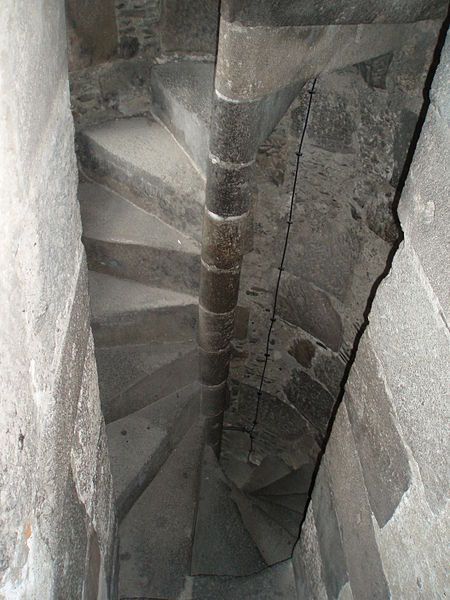
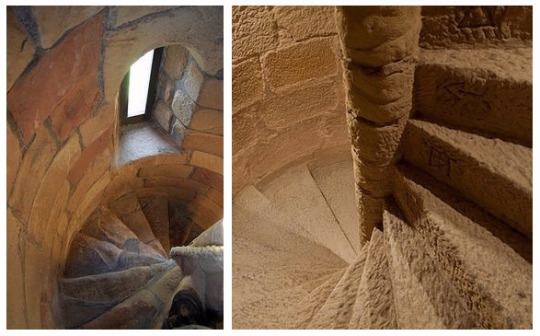
Not really the best illustration since it totally negates the effect by having a wide open space for those ascending. Castle tower staircases tended to look like this:

Extremely tight quarters, with a central supporting pillar that is very, very thoroughly in the way of your right arm.

Wider, less steep designs tend to come later once castles moved away from being fortresses to simply noble family homes with the advent of gunpowder.

Oh! Pre-gunpowder military tactics are my jam! I don’t know why, but this is one of my favorite little details about defensive fortifications, because the majority handedness of attackers isn’t usually something you think about when studying historical wars. But strategically-placed walls were used basically worldwide as a strategy to secure gates and passages against advancing attackers, because most of the world’s population is right-handed (and has been since the Stone Age).

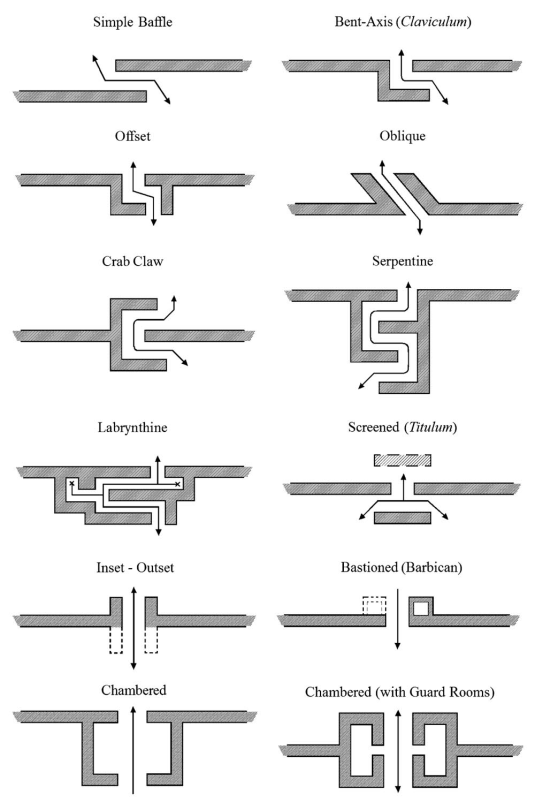
Pre-Columbian towns near the Mississippi and on the East coast did this too. They usually surrounded their towns with palisades, and they would build the entrance to the palisade wall in a zigzag – always with the wall to the right as you entered, to hinder attackers and give an advantage to the defender. Here’s some gates with some examples of what I’m talking about:

image

Notice that, with the exception of the last four (which are instead designed to congregate the attackers in a space so they can be picked off by archers, either in bastions or on the walls themselves) and the screened gate (which, in addition to being baffled, also forces the attackers to defend their flank) all of these gates are designed with central architectural idea that it’s really hard to kill someone with a wall in your way.

In every culture in the world, someone thought to themselves, “Hey it’s hard to swing a weapon with a wall on your right-hand side,” and then specifically built fortifications so that the attackers would always have the wall on their right. And I think that’s really neat.

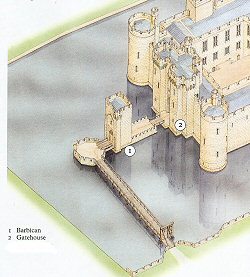
Ooh, ooh, also: Bodiam Castle in Sussex used to have a right-angled bridge so any attacking forces would be exposed to archery fire from the north-west tower on their right side (ie: sword in the right hand, shield on the useless left side):

These tactics worked so well for so long because until quite recently lefties got short shrift and had it trained (if they were lucky) or beaten out of them.

Use of sword and shield is a classic demonstration of how right-handedness predominated. There’s historical mention of left-handed swordsmen (gladiators and Vikings), and what a problem they were for their opponents, but that only applies to single combat.

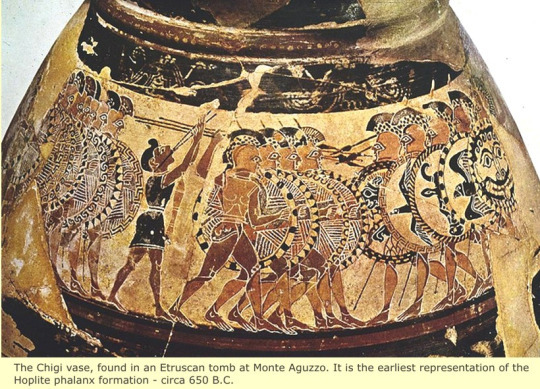
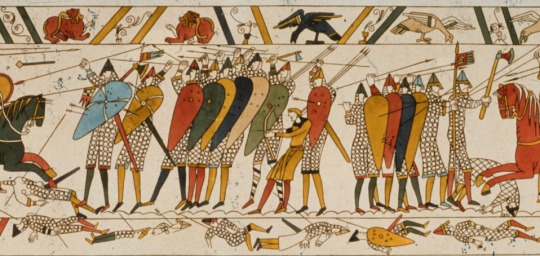
A left-handed hoplite or housecarl simply couldn’t fight as part of a phalanx or shield wall, since the shields were a mutual defence (the right side of the shield covered its owner’s left side, its left side covered the right side of his neighbour to the left, and so on down the line) and wearing one on the wrong arm threw the whole tactic out of whack.

image
image

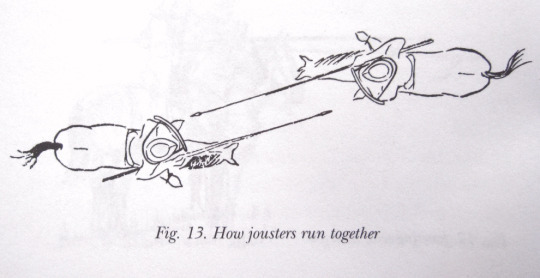
Jousting, whether with or without an Italian-style tilt barrier, was run shield-side to shield-side with the lance at a slant (except for the Scharfrennen, a highly specialised style that’s AFAIK unique.) Consequently left-handed knights were physically unable to joust.

image

There’s a creditable theory (I first read it in “A Knight and His Horse”, © Ewart Oakeshott 1962, 1998 and many other places since) that a knight’s “destrier” horse – from dexter, “right” – was trained to lead with his right forefoot so that any instinctive swerve would be to the right, away from collision while letting the rider keep his shield between him and harm. (In flying, if a pilot hears “break!” with no other details, the default evasive direction is right.)

The construction of plate armour, whether specialised tournament kit or less elaborate battle gear, is noticeably “right-handed“ – so even if a wealthy knight had his built “left-handed” it would be a waste of time and money; he would still be a square peg in a world of round holes and none of the other kids would play with him.

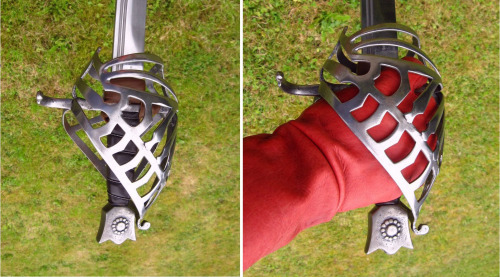
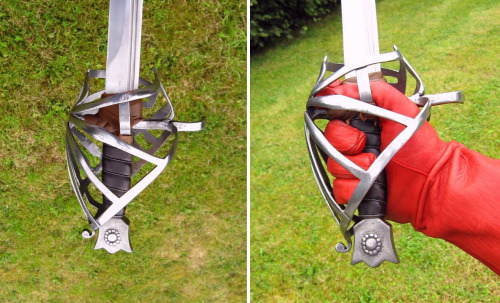
Even after shields and full armour were no longer an essential part of military equipment, right-hand use was still enforced until quite recently, and to important people as well as ordinary ones – it happened to George VI, father of the present Queen of England. Most swords with complex hilts, such as swept-hilt rapiers and some styles of basket-hilt broadsword, are assymetrical and constructed for right handers. Here’s my schiavona…

image
image

It can be held left-handed, but using it with the proper thumb-ring grip, and getting maximum protection from the basket, is right-handed only. (More here.) Some historical examples of left-hand hilts do exist, but they’re rare, and fencing masters had the same “learn to use your right hand” bias as tourney organisers, teachers and almost everyone else. Right-handers were dextrous, but left-handers were sinister, etc., etc.

However, several
predominantly left-handed

families did turn their handedness into advantage, among them the Kerrs / Carrs, a notorious Reiver family along the England-Scotland Borders, by building their fortress
staircases with a spiral the other way to the OP image.

image

This would seem to be a bad idea, since the attackers (coming upstairs) no longer have their right arms cramped against the centre pillar – however it worked in the Kerrs’ favour because they were used to this mirror-image of reality while nobody else was, and the defender retreating up the spiral had that pillar guarding his right side, while the attacker had to reach out around it…

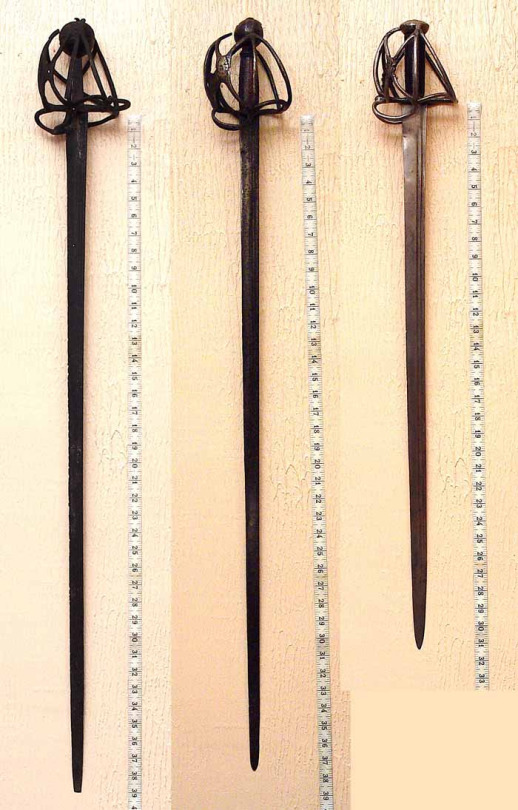
For the most part Reiver swords weren’t elaborate swept-hilt rapiers but workmanlike basket-hilts. Some from Continental Europe have the handedness of my schiavona with thumb-rings and assymmetrical baskets, but the native “British Baskethilt” is a variant of the Highland claymore* and like it seems completely symmetrical, without even a thumb-ring, which gives equal protection to whichever hand is using it.

image

*I’m aware there are those who insist “claymore” refers only to two-handers, however the Gaelic term claidheamh-mòr
– “big sword” –

just refers to size, not to a specific type of sword in the way “schiavona” or “karabela” or even “katana” does.

While the two-hander was the biggest sword in common use it was the
claidheamh-mòr; after it dropped out of fashion and the basket-hilt became the biggest sword in common use, that became the
claidheamh-mòr.

When Highlanders in the 1745 Rebellion referred to their basket-hilts as claymores, they obviously gave no thought to the confusion they would create for later compilers of catalogues…

Also, muskets had their whole “Flint and steel and gunpowder” thing on the right side so if you tried firing it lefty you’d get a face full of fire. More recently, rifles eject their spent shell casings to the right, so if you’re a lefty you get some hot metal in your eye.

good post this is a gOOD POST

heavyweightheart:

Research has shown that pleasure affects nutrient absorption. In a 1970s study of Swedish and Thai women, it was found that when the Thai women were eating their own (preferred) cuisine, they absorbed about 50% more iron from the meal than they did from eating the unfamiliar Swedish food. And the same was true in the reverse for the Swedish women. When both groups were split internally and one group given a paste made from the exact same meal and the other was given the meal itself, those eating the paste absorbed 70% less iron than those eating the food in its normal state.

Pleasure affects our metabolic pathways; it’s a facet of the complex gut-brain connection. If you’re eating foods you don’t like because you think it’s healthy, it’s not actually doing your body much good (it’s also unsustainable, we’re pleasure-seeking creatures). Eat food you enjoy, it’s a win-win.