optimysticals:

squeeful:

bemusedlybespectacled:

maxiesatanofficial:

pervocracy:

kvothbloodless:

macaedh:

what the fuck ethan

I wish i had a context for this. But I really dont.

I was all ready to “um, actually” this, but, um, actually there’s about 3-4 grams of iron in a person, which x400 is 1.2-1.6kg, which is a smallish but not unreasonable sword. So. Math checks out.

How would you extract the iron, though? The more practical solution would be to kill a mere hundred men, then mix 1 part blood with 3 parts standard molten iron, imo. Cheaper and faster, while still retaining the edge that only evil magic can give you.

Or, you could just make the sword of iron, and then use the blood to temper the blade.

1.2 to 1.6 kilograms is a perfectly reasonable large sword.  Your average longsword was 1.1–1.8 kg and I don’t even remember if that’s including the weight of the hilt, guard, and pommel or just the blade.  Your more classic “knight sword” was a mere 1.1 kilograms on average; the blood of 400 men is more than enough.

This is using the comparatively crappy metallurgy of medieval Europe and their meh iron swords.  Move east to, say, contemporary Iran and make a scimitar using high carbon steel (~2%) for a .75 kilogram blade and you only need the blood of about 225 men.

So putting my thoughts in on this… because how could I not.

So you’ve exsanguinated your 400 guys to get the iron for your sword. Cool. But now you have 400 bodies lying around.

Why not put those to good use and cremate them. Use the carbon from those 400 bodies (you won’t need all of them) and now you can make a nice mid-high carbon steel sword.

Now you have a sword forged with the blood of your enemies AND strengthened with their bones.

as you know, the immune system walks a fine line between being absolutely useless and killing you

immunology professor this week (via hyacinth-willow)

I mean, a fever is basically your immune system going, “LET’S SEE WHO BURNS FIRST, MOTHERFUCKER.”

(via thebastardofgloucester)

#ALSO MOST DEADLY ILLNESSES ARE ONLY DEADLY BECAUSE YOUR IMMUNE SYSTEM IS TRYING TO HELP

(via fightthecoldwithspices)

nubbsgalore:

built five hundred feet into the permafrost of a norwegian island located some six hundred miles from the north pole (and twice that from oslo), the svalbard global seed vault is the world’s largest and most secure seed bank. 

safe from earthquake and flooding, and designed to last a thousand years, its mission is to serve as a backup for planet’s agriculture in the event of a catastrophe, be it from drought, floods, disease, war (see: syria) and/or the slow moving disaster of climate change.

known as the doomsday vault, it has amassed over 840,000 seed samples since the first deposit, that of rice seeds, was made in 2008 by the late kenyan environmental activist and nobel peace prize winner, wangari maathai. 

since then, all countries, save japan and china (the later of which is believed to have already lost 90 percent of its rice varieties) have entrusted the site with their agricultural heritage, and the collection, as of now, covers about half of the world’s known crop diversity. 

NASA has trialled an engine that would take us to Mars in 10 weeks

mindblowingscience:

NASA scientists have reported that they’ve successfully tested an engine called the electromagnetic propulsion drive, or the EM Drive, in a vacuum that replicates space. The EM Drive experimental system could take humans to Mars in just 70 days without the need for rocket fuel, and it’s no exaggeration to say that this could change everything.

But before we get too excited (who are we kidding, we’re already freaking out), it’s important to note that these results haven’t been replicated or verified by peer review, so there’s a chance there’s been some kind of error. But so far, despite a thorough attempt to poke holes in the results, the engine seems to hold up.

Continue Reading.

NASA has trialled an engine that would take us to Mars in 10 weeks

wolfayal:

hogwartshiddenswimmingpool:

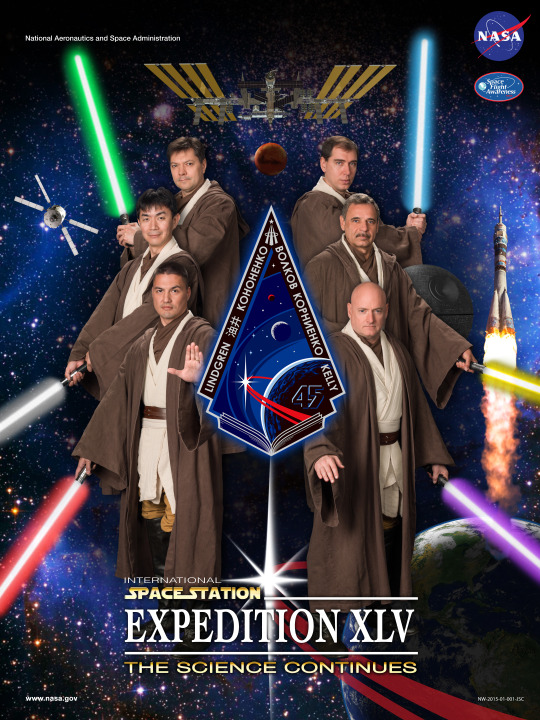
This is Kjell Lindgren. He’s a NASA astronaut who just got back from 5 months on the International Space Station. There are two reasons why this picture is hilarious:

  1. His wife is flawless and makes bad space puns to make him do household chores.
  2. I have that shirt. Thousands of people have that shirt. That shirt is available at Target. Which means actual astronaut Kjell Lindgren, with his wardrobe already full of NASA-issued and logo-emblazoned clothes, was at Target, saw a NASA shirt, and was like, “Yes, I am buying this because this is what I want to spend my actual astronaut salary on.”

 tl;dr NASA employs a bunch of fucking nerds

It gets better.

Courtesy of Wikipedia, here’s the poster NASA released for his mission to the ISS:

morningchai:

wiccateachings:

The solar system is all set to give a rare celestial show. Mercury, Venus, Saturn, Mars and Jupiter will all be visible from Earth when they appear in a diagonal line on Wednesday, Jan. 20. It’s the first time the five bright planets, so called as they can usually be seen easily with the naked eye, have aligned in such a way in more than 10 years. The phenomenon will continue until Feb. 20.

!!!!!!!!!!!!!!!!!!!!!!!!

npr:

The astronomer whose work helped kick Pluto out of the pantheon of planets says he has good reason to believe there’s an undiscovered planet bigger than Earth lurking in the distant reaches of our solar system.

That’s quite a claim, because Mike Brown of Caltech is no stranger to this part of our cosmic neighborhood. After all, he discovered Eris, an icy world more massive than Pluto that proved our old friend wasn’t special enough to be considered a full-fledged planet. He also introduced the world to Sedna, a first-of-its-kind dwarf planet that’s so far out there, its region of space was long thought to be an empty no man’s land.

Now Brown has teamed up with Caltech colleague Konstantin Batygin to do a new analysis of oddities in the orbits of small, icy bodies out beyond Neptune. In their report published Wednesday in The Astronomical Journal, the researchers say it looks like the orbits are all being affected by the presence of an unseen planet that’s about 10 times more massive than Earth (though still much smaller than Uranus or Neptune) — the size astronomers refer to as a super-Earth.

Scientists Find Hints Of A Giant, Hidden Planet In Our Solar System

Image: The imagined view from Planet Nine back toward the sun. Astronomers think the huge, distant planet is likely gaseous, similar to Uranus and Neptune.

s-c-i-guy:

Where Could Life Exist?

When NASA scientists announced earlier this year that they had found evidence of liquid water on Mars, imaginations ran wild with the possibility that life could exist somewhere other than here on Earth.

Scientists continue to explore the possibility that Mars once looked a lot like Earth — salty oceans, fresh water lakes, and a water cycle to go with it. That’s exciting stuff.

So where else are they looking? What exactly are they looking for?

There are nine places in our universe where scientists say life is a possibility. The locations range from a smoking hot planet like Venus to a moon that orbits Saturn called Enceladus, which looks a lot like a massive, tightly-packed ball of ice.

All of these places show signs that water is, or at least was, a possibility. They also appear to feature some kind of energy that could produce heat.

full resolution